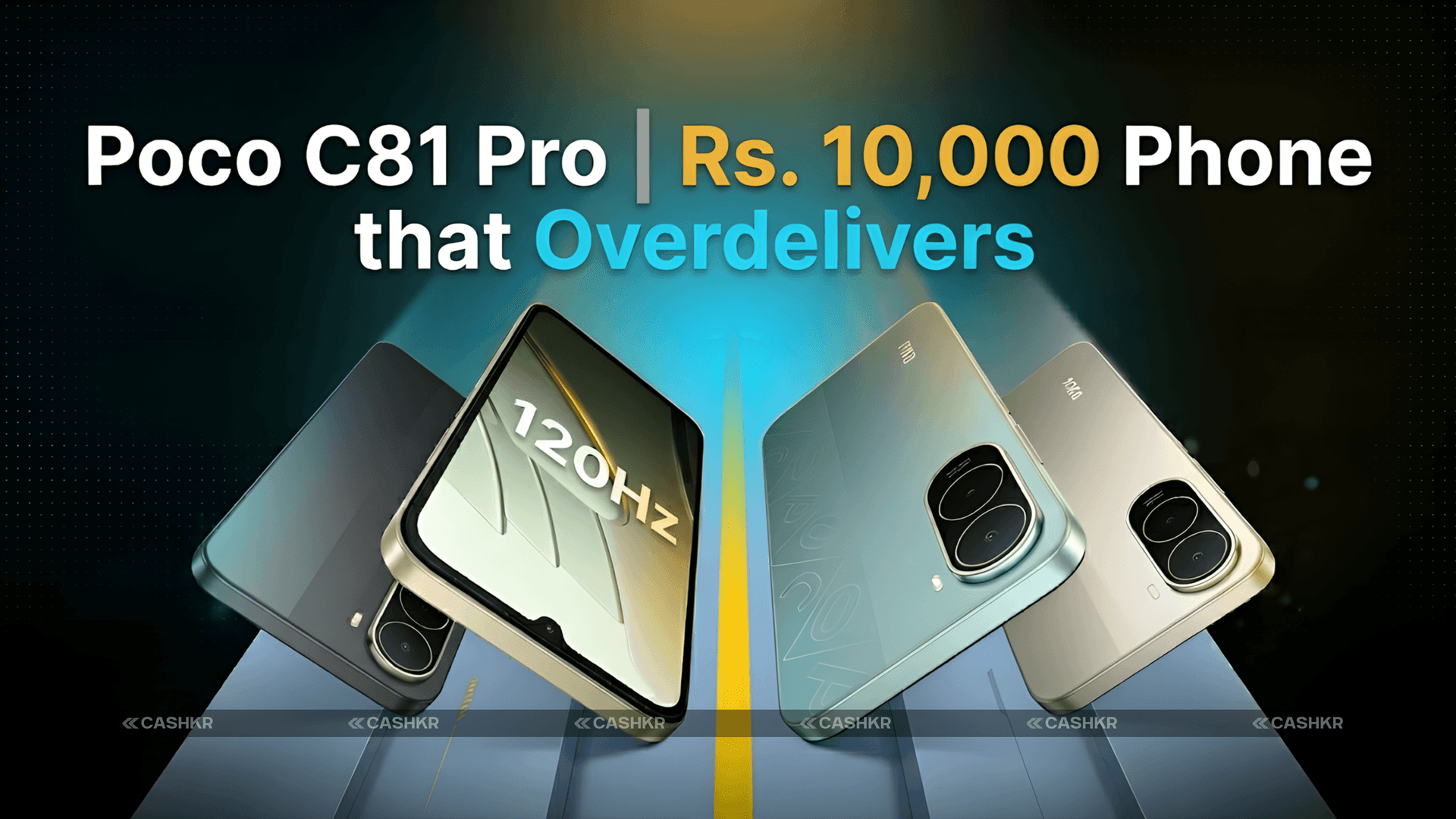
Poco C81 Pro Price, 6,000mAh Battery, and Full Specifications: The Best Under Rs. 10,000 Phone You Have Not Heard About Yet
Under Rs. 10,000. A thirteen-hundred-to-one contrast ratio. Triple TUV Rheinland display certification. NFC. Six thousand milliamp hours of battery. A 120Hz screen. These are not numbers you expect from a phone in this range. But here we are.
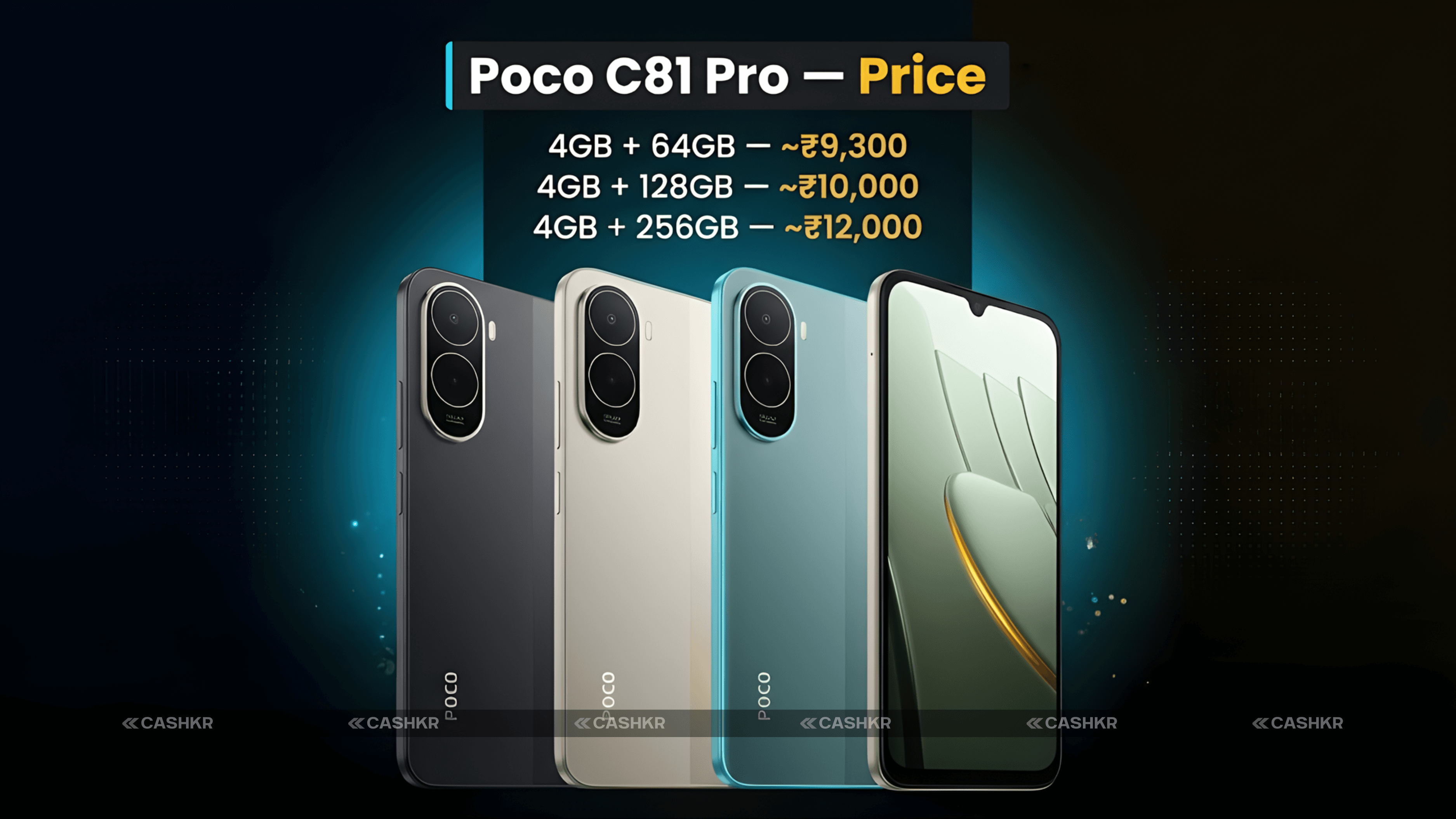
The Poco C81 Pro price starts at just USD 99 globally, which is approximately Rs. 9,300 at current exchange rates for the 4GB plus 64GB base variant. Three storage options are available: the 128GB variant at USD 109 (approximately Rs. 10,000) and the 256GB at USD 129 (approximately Rs. 12,000). The phone has launched in select international markets, with India availability yet to be confirmed.
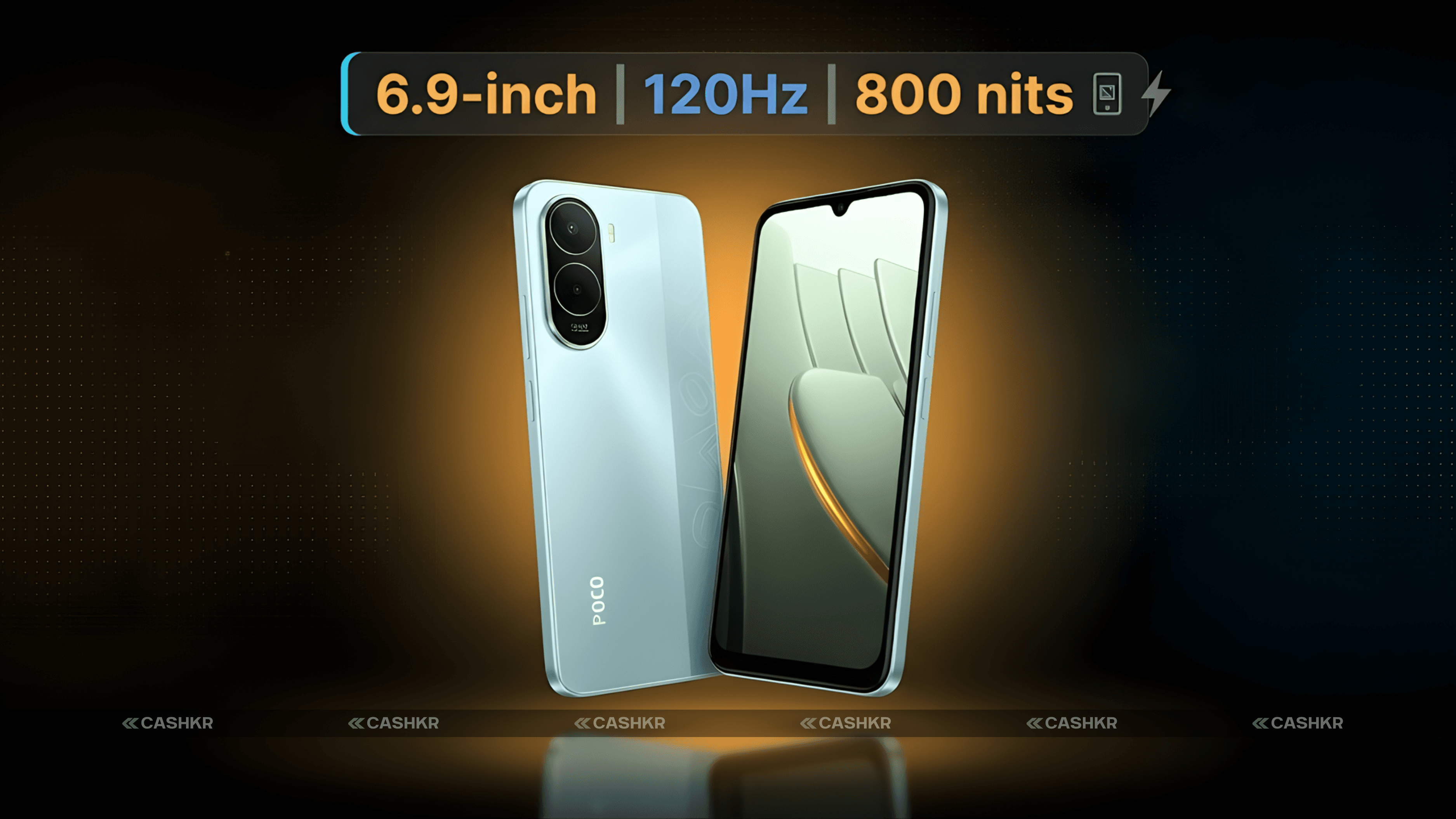
At the Poco C81 Pro price, the phone delivers a 6.9-inch 120Hz LCD with 800 nits peak brightness, triple TUV Rheinland eye protection certifications, a Unisoc T7250 chip on 12nm, up to 4GB plus 8GB virtual RAM, NFC for contactless payments, a 13MP rear camera with an AI-assisted secondary lens, an 8MP selfie camera, wet touch technology, a side fingerprint sensor, USB-C, and a 3.5mm headphone jack alongside the 6,000mAh battery with 15W charging. Poco has packed this phone like it is running out of space to add things.
Here is why it matters and what it is actually like to use.
Poco C81 Pro price: USD 99 (~Rs. 9,300) for 4GB+64GB | USD 109 (~Rs. 10,000) for 4GB+128GB | USD 129 (~Rs. 12,000) for 4GB+256GB | Global launch in select markets | India TBC | 6.9-inch 120Hz 800 nits LCD | Unisoc T7250 (12nm) | 4GB RAM plus 8GB virtual | 6,000mAh | 15W charging | 13MP rear | 8MP front | NFC | USB-C | 3.5mm jack | Side fingerprint | HyperOS 3.
Poco C81 Pro Price: Three Variants and Who Each One Is Right For
Every rupee matters at this price point. Here is the Poco C81 Pro price breakdown and which variant actually makes sense:
Variant
Price
Who Should Buy This
4GB + 64GB
USD 99 (~₹9,300)
Best for light users, first-time phone buyers, and gifting
4GB + 128GB
USD 109 (~₹10,000)
Sweet spot: enough storage for photos, apps, and music
4GB + 256GB
USD 129 (~₹12,000)
Best value: large storage, rarely needs microSD
The 128GB variant at approximately Rs. 10,000 is the one most buyers should target. The 64GB base is fine for a light user, but photos, WhatsApp caches, downloaded music, and a handful of apps fill 64GB faster than most people expect. The 256GB at Rs. 12,000 is generous storage for this price, but the Rs. 2,000 premium over the 128GB is only worth it if you specifically want to avoid managing storage entirely.
All three variants share the same components, including the chip, display, cameras, battery, and NFC. You are only paying for more storage.
Poco India has not confirmed an India launch date or official India pricing. Based on Poco's typical India pricing pattern, the base variant is expected in the Rs. 7,999 to Rs. 9,999 range when it arrives. Watch Flipkart and Poco India's official channels for any announcement.
India launch not yet confirmed. All INR prices above are direct USD to INR conversions. Actual India pricing will be set by Poco India at the India launch event and may differ from these figures.
At this price, compromises are expected. But the Poco C81 Pro makes some choices that phones twice its price do not always make. Here is what stands out.
6,000mAh battery at under Rs. 10,000: The Redmi A7 Pro 4G at Rs. 11,999 has 6,300mAh. Most entry-level phones at Rs. 8,000 to Rs. 10,000 carry 4,500mAh to 5,000mAh. The Poco C81 Pro at 6,000mAh delivers two full days of moderate use for most buyers. That is genuinely unusual at this price.
120Hz display with 800 nits of brightness: Most phones at this price point run 60Hz displays. A 120Hz panel at Rs. 9,300 means scrolling through social media, swiping between apps, and navigating menus all feel visibly smoother. The 800 nits high-brightness mode means the screen is readable outdoors in bright sunlight.
Triple TUV Rheinland certification: low blue light, circadian friendly, and flicker free. Three independent certifications from TUV Rheinland cover the most common display-related eye strain concerns. For a student or worker who stares at this screen for several hours a day, these certifications reflect real testing rather than a marketing claim.
NFC at this price: NFC allows contactless payments via Google Pay and other UPI-linked payment apps at NFC-enabled POS terminals. Entry-level phones almost never have NFC. The Poco C81 Pro having it at under Rs. 10,000 makes it a more practical daily device than most of its direct competitors.
USB-C and 3.5mm headphone jack together: Two things many mid-range phones have dropped. Having both means you can charge using any modern USB-C cable while still using wired earphones with any standard 3.5mm plug. No adapter needed for either.
Wet Touch Technology 2.0: The display responds to touch even when your fingers are wet, soapy, or oily. Cooking, washing hands, working outdoors in the rain. This is the kind of feature that sounds like a minor add-on until the day you actually need it.
The Display: Big, Smooth, and Certified for Extended Use
The 6.9-inch HD Plus LCD at 120Hz is a large screen for a phone at this price. Watching YouTube, reading, scrolling through Instagram, and playing games all benefit from the additional screen area compared to the 6.5-inch panels more common in this segment.
HD Plus at 1600 by 720 pixels across a 6.9-inch panel produces a pixel density around 255 PPI. The text is readable, and the images look clear at normal viewing distances. It is not the razor-sharp display of a Full HD Plus phone, but it is more than adequate for everything this phone is designed to do.
The 1500:1 contrast ratio means dark scenes in videos and games show meaningful depth rather than a flat grey. The 650 nits typical brightness and 800 nits peak brightness handle indoor environments comfortably and outdoor viewing in bright conditions respectably.
The water drop notch is the classic small notch that has a teardrop-shaped cutout at the top center of the screen for the selfie camera. It takes up less screen space than an older thick notch and is a familiar design that most users are comfortable with at this price tier.
Performance: Unisoc T7250 and Virtual RAM Expansion
The Unisoc T7250 on a 12nm process is the chip running the Poco C81 Pro. It is an octa-core chip with a Mali-G57 GPU. This is an entry-level chip designed for light everyday tasks rather than heavy gaming or demanding applications.
What it does well: WhatsApp, calls, Instagram, YouTube, Google Maps, UPI apps, basic photography, and light gaming like Subway Surfers, Ludo King, and Candy Crush. All of these run smoothly without slowdown.
What it will struggle with: Demanding games like BGMI at anything above low settings, video editing, and running many apps in the background simultaneously at full speed. This is a phone for everyday tasks, not a performance device.
The virtual RAM expansion is worth mentioning. The phone has 4GB of physical LPDDR4X RAM and can expand this virtually to 8GB by using storage space as overflow memory. Virtual RAM is not as fast as physical RAM, but it meaningfully reduces the frequency with which apps reload from scratch when you switch back to them. For a 4GB base phone, this makes daily multitasking noticeably more comfortable. The 256GB UFS 2.2 storage at the top configuration is reasonably fast for app launches and file access. Storage can also be expanded further using a MicroSD card.
HyperOS 3 on a budget phone: Poco runs HyperOS 3 on the C81 Pro, which is Xiaomi's latest software interface built on Android. HyperOS 3 is cleaner and faster than the older MIUI that Poco used to ship. For a budget phone, the software experience matters as much as the hardware. A smoother software layer on modest hardware makes the phone feel faster than it technically is.
Camera: 13MP Main and 8MP Selfie With AI Processing
The Poco C81 Pro has a 13MP primary rear camera at f/2.2 with an AI-assisted auxiliary lens and an 8MP selfie camera at f/2.0.
Let us be honest about what 13MP at f/2.2 means in a phone at this price. In good daylight, the camera produces clear and sharp enough photos for WhatsApp sharing and social media. Photos of food, friends, places, and everyday moments come out usable and sometimes genuinely good.
In low light or indoors without much natural light, the results are average. Noise increases and detail drops. This is expected for any budget phone camera and is not a failing unique to this model. It is physics.
The AI processing on the rear camera helps with scene recognition and some automatic color and exposure adjustments. It does not turn a budget sensor into a flagship one, but it reduces the number of badly exposed shots in typical shooting scenarios.
The 8MP selfie at f/2.0 is a bright aperture for a front camera at this price. The wider f/2.0 aperture admits more light than the typical f/2.2 on most competing budget selfie cameras, producing better lit selfies in indoor and dim conditions.
Battery and Charging: Two Days and Then Some
The 6,000mAh battery is the specification that most buyers at this price will cite as their main reason for choosing the Poco C81 Pro. And rightly so.
Poco claims more than 79 hours of music playback on a single charge. That is three and a quarter days of continuous music from a fully charged phone. For actual mixed use, including calls, messages, social media, some video, and light gaming, two full days between charges is a realistic expectation for a moderate user.
The 15W fast charging fills the 6,000mAh from empty in approximately 2.5 to 3 hours. This is not fast by 2026 standards, where 45W to 90W is common on mid-range phones, but for a phone at this price with this battery size, 15W is the expected trade-off. Plug it in overnight, and you start every day full.
Poco C81 Pro Price vs. Competition: Does It Win?
At the Poco C81 Pro price equivalent in India, here is how it stacks up against the phones most likely to compete with it:
Redmi A7 Pro 4G (Rs. 11,999 in India): The Redmi A7 Pro is the closest direct comparison. It has a larger 6,300mAh battery, Android 16 with 4 years of updates, a 120Hz display, and Rs. 11,999 confirmed India pricing. The Poco C81 Pro beats it on NFC, the Wet Touch feature, and potentially price if it lands below Rs. 10,000 in India. The Redmi wins on software support longevity.
Samsung Galaxy A06 (Rs. 9,999): The Galaxy A06 has a better Exynos 850 chip and a 50MP camera. It lacks NFC and a 120Hz display. The Poco C81 Pro wins on display smoothness, battery size, and NFC. The Samsung wins on camera resolution and chip performance. Different priorities for different buyers.
Realme C100 (Rs. 11,999): The Realme C100 has an 8,000mAh battery, which beats the C81 Pro on raw capacity but is 4G only. The Poco C81 Pro has 5G support, NFC, and 120Hz over the C100. For buyers who want to future-proof for 5G and use contactless payments, Poco wins.
Wi-Fi, Bluetooth 5.2, GPS, GLONASS, Galileo, BeiDou, NFC, USB-C
Audio Jack
3.5mm
Dimensions
171.56 × 79.47 × 8.15mm
Weight
208g
Colors
Black, Gold, Green
Final Verdict
The Poco C81 Pro is not trying to impress anyone who reads benchmark sheets. It is trying to be the most practical, capable, and dependable phone possible for a buyer spending under Rs. 10,000 in India.
The Poco C81 Pro price makes it one of the best value propositions in the entry segment if it lands in India at a competitive figure. The specifications of six thousand milliamp hours of battery, a 120Hz screen, NFC, triple TUV certification, USB-C, a 3.5mm jack, and Wet Touch, all priced under Rs. 10,000, are features that most competing phones in this price range do not simultaneously offer. It is not a phone without trade-offs, but the trade-offs it makes are the right ones for the buyer it is built for.
Bottom Line: The Poco C81 Pro price is from USD 99 (~Rs. 9,300) globally. India launch TBC: 6.9-inch 120Hz 800 nits LCD. Triple TUV Rheinland certified. Unisoc T7250 (12 nm). 4 GB RAM plus 8 GB virtual. Up to 256GB UFS 2.2. 6,000 mAh with 15 W charging. 13MP rear. 8MP front. NFC. USB-C. 3.5mm jack. Side fingerprint. HyperOS 3. Black, gold, and green colors.
FAQs
1. What is the Poco C81 Pro price?
The Poco C81 Pro price globally starts at USD 99 (approximately Rs. 9,300) for the 4GB plus 64GB variant. The 128GB storage model is USD 109 (approximately Rs. 10,000), and the 256GB is USD 129 (approximately Rs. 12,000). India pricing has not been officially confirmed.
2. When will the Poco C81 Pro launch in India?
Poco India has not confirmed an India launch date. The phone has launched in select international markets. Watch Poco India's official channels and Flipkart for any launch announcements.
3. What makes the Poco C81 Pro stand out at this price?
NFC for contactless payments, a 120Hz display with 800 nits peak brightness, triple TUV Rheinland eye protection certifications, a 6,000mAh battery, Wet Touch Technology 2.0, USB-C, and a 3.5mm headphone jack all together under Rs. 10,000 is an unusual combination. Most competing phones at this price have only some of these features.
4. Does the Poco C81 Pro support 5G?
The Unisoc T7250 chip in the Poco C81 Pro supports 5G connectivity, making it a 5G-capable phone at under Rs. 10,000.
5. What is virtual RAM expansion on the Poco C81 Pro?
The phone has 4GB of physical RAM. Virtual RAM expansion uses a portion of the phone's internal storage as additional memory, effectively giving apps more space to stay open in the background. This reduces how often apps reload from scratch when you switch back to them. Virtual RAM is slower than physical RAM but noticeably improves multitasking on 4GB devices.
6. Does the Poco C81 Pro have NFC?
Yes. NFC is included at all three storage configurations. This allows contactless payments via Google Pay and other NFC-enabled UPI payment apps at POS terminals. NFC is rarely found in phones under Rs. 10,000, making its presence on the Poco C81 Pro a meaningful practical advantage.
7. What is the battery life of the Poco C81 Pro?
Poco claims more than 79 hours of music playback. For mixed daily use, including calls, messaging, social media, and some video, two full days between charges is a realistic expectation for a moderate user. The 15W wired charging fills from empty in approximately 2.5 to 3 hours.
8. What does Wet Touch Technology 2.0 do?
The display responds to touch even when your fingers are wet, soapy, or oily. This is useful while cooking, after washing hands, in rain or in any situation where keeping your hands completely dry before using the phone is not practical.
9. Is the Poco C81 Pro good for gaming?
The Unisoc T7250 handles casual mobile games smoothly. Ludo King, Subway Surfers, Candy Crush, and similar games run without any problem. For demanding games like BGMI or Free Fire at higher settings, the chip will show its limitations. The Poco C81 Pro is an everyday phone, not a gaming phone.
10. How does the Poco C81 Pro price compare to the Redmi A7 Pro 4G in India?
The Redmi A7 Pro 4G is confirmed in India at Rs. 11,999. The Poco C81 Pro is expected to land below Rs. 10,000 in India when it launches. The Redmi A7 Pro has a larger 6,300mAh battery, Android 16, and a stronger 4-year software update promise. The Poco C81 Pro has NFC, a 120Hz display, and Wet Touch technology. If price is the deciding factor and NFC matters, Poco wins. If long-term software support matters most, Redmi wins.
If you want to sell your old devices, then click here.
Stay in the loop
Weekly tech insights in your inbox. No spam, ever.


 Yaskar Jung ShahUpdated: Jul 28, 2026·17 min read