Most people have an old phone or laptop in a drawer. It is not broken enough to throw away and not good enough to use. So it sits there.
This guide explains what to actually do with it. What the law in India says. What counts as e-waste. How to safely remove your data. And how to decide whether to sell, give away, or recycle your device, because those are three different answers.
The Numbers, and What They Really Say
You will see some alarming figures on this subject. Here are the real ones, with their sources.
Advertisement
Around the world. In 2022, the world threw away 62 million tonnes of electronic waste. Only 22.3 percent of it was properly collected and recycled. That is expected to reach 82 million tonnes by 2030, while the share properly recycled falls to about 20 percent. Those metals are worth roughly 91 billion dollars a year. (UN Global E-waste Monitor 2024, published by the ITU and UNITAR.)
In India. India generated 13.98 lakh tonnes of e-waste in the year 2024-25. About 9.88 lakh tonnes were processed, which is around 70 percent. In 2017-18, the figure generated was 7.08 lakh tonnes, so it has roughly doubled in eight years. (Central Pollution Control Board data, given in a written reply in the Rajya Sabha on 24 July 2025.)
That 70 percent figure often surprises people, since stories about e-waste in India usually sound much worse. Two important things to keep in mind: this number includes only devices processed through the official system, so it excludes anything handled by informal scrap dealers. Also, e-waste is still increasing quickly. Still, within the official system, India is actually doing better than the global average.
Why the waste matters. Old electronics contain gold, silver, copper, and rare metals worth recovering. They also have lead, mercury and cadmium. When devices are burned or taken apart by hand outside, the World Health Organization says this can release up to 1,000 different harmful chemicals, and children often do this work. That is the real danger, and it happens in the informal system, not in official recycling centers.
What Counts as E-Waste
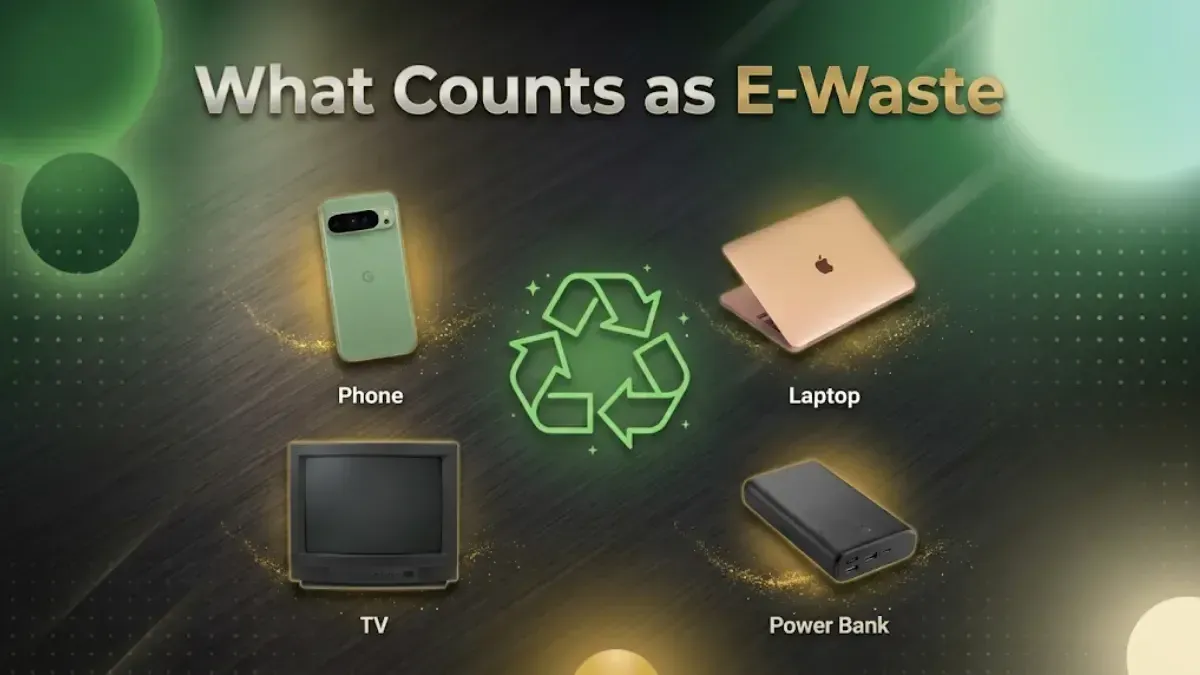
Almost anything with a plug or a battery.
Phones, laptops, tablets, smartwatches, fitness bands, headphones, televisions, monitors, printers, routers, set top boxes, gaming consoles, cameras, chargers, cables, power banks, and small kitchen appliances.
India's E-Waste Management Rules cover 106 categories of equipment, including solar panels.
The Law in India, in Plain Words
The E-Waste (Management) Rules, 2022 were notified on 2 November 2022 and came into force on 1 April 2023. They replaced the 2016 rules and widened the scope from 21 categories of equipment to 106.
The main idea is Extended Producer Responsibility, or EPR. It means the company that sold you the device is responsible for what happens to it at the end of its life, not just for selling it. Producers must sign up on a website run by the Central Pollution Control Board and meet recycling goals: 60 percent for 2023 to 2025, 70 percent for 2025 to 2027, and 80 percent from 2027 onwards.
What this means for you. The rules place the legal duty on producers, recyclers, dismantlers, and refurbishers, not ordinary households. You are not breaking a law by keeping an old phone in a drawer.
But it does mean something useful. Every major brand selling in India has to run a takeback route, because that is how they meet their targets. You can use it, and it is free.
Sell, Hand Down, or Recycle: Pick the Right One
This is the part most guides skip, and it matters.
Recycling should be your last option, not your first. Recycling breaks the device down to recover materials, while reuse keeps the whole device working. If a phone gets a second owner, it prevents a new phone from being made, which saves much more than just recovering a few grams of metal.
So work down this list.
1. Does it still work? If yes, sell it or pass it on. Even an old working phone is valuable to someone. This is the best result for both you and the environment.
2. Is it broken but can be fixed? Sell it anyway, at a lower price. Buyback services and repair shops buy damaged devices because the working parts still have value. Do not fix a crack just to sell it; the repair usually costs more than it adds.
3. Is it completely dead? Then it is time to recycle it. If it will not turn on, the board is damaged, or it is too old for anyone to want, breaking it down is the right choice.
Our guide on what to do with old phones walks through each of these in more detail.
How to Actually Recycle a Device in India
There are four free ways to recycle your device.
1. The brand's own takeback. Apple, Samsung, Dell, HP, LG, Xiaomi and the other major brands all run collection programmes in India, because EPR requires it. Search the brand name plus "e-waste" or "recycling" to find their form or helpline. Some will collect from your home.
2. An approved recycler or dismantler. These are companies registered with the Central Pollution Control Board or your State Pollution Control Board. They are the ones legally allowed to take devices apart. Ask for their registration number. A real one will give it.
3. Your municipal collection point. Many cities now run e-waste drop-off days or permanent bins. Check your municipal corporation website.
4. A buyback service, if the device still has any life. This is our own business, and it only applies to devices that can be refurbished or stripped for parts. It is not recycling in the strict sense. It is reuse, which is better.
You should avoid selling to someone who comes to your door offering cash for old electronics. This is part of the informal system. Your phone will probably be taken apart by hand, the useful parts sold, and the rest burned or dumped. That is how the WHO's 1,000 harmful chemicals are released.
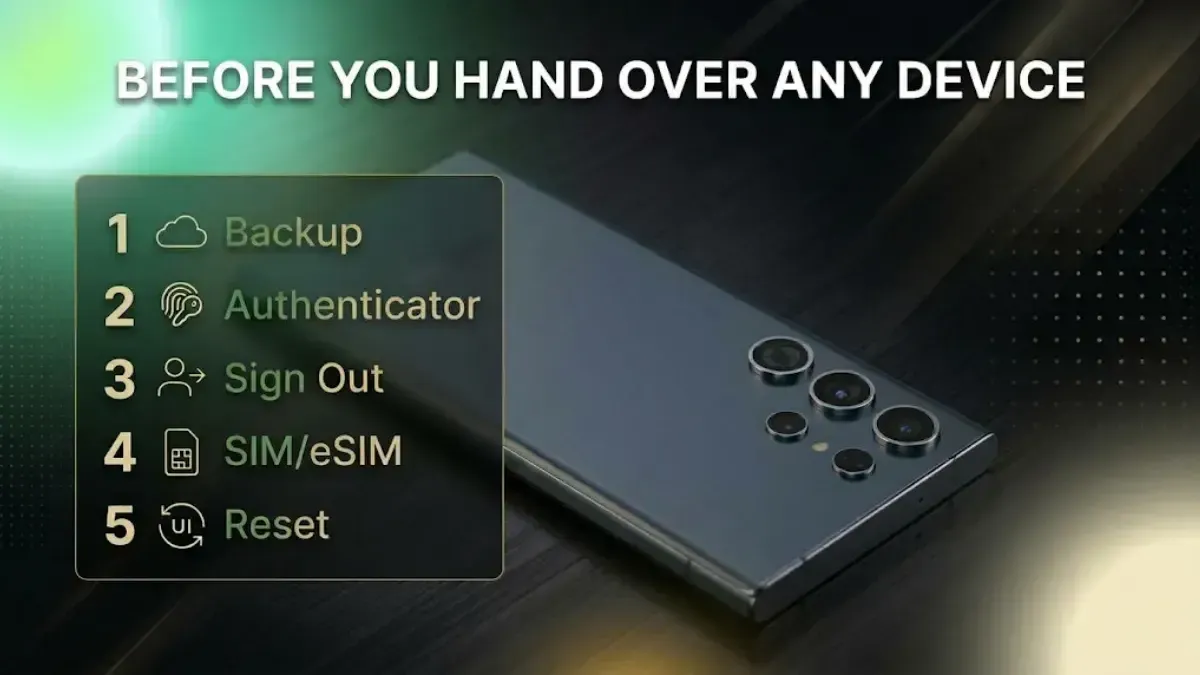
Before You Hand Over Any Device
Follow these steps in order. The sequence matters.
1. Back up your data. Back up photos, contacts, messages, chats, and anything in Downloads. Check the backup worked by signing in from another device.
2. Move your authenticator app to your new device if you use one for login codes. These are the hardest thing to recover.
3. Sign out of your Google or Apple account. On iPhone: Settings, your name, Find My, switch off Find My iPhone, then Sign Out. On Android: Settings, Accounts, remove your Google account.
4. Take out the SIM and memory card, and remove any eSIM. A factory reset does not always clear an eSIM.
5. Now factory reset.
Our checklist of things to do before you sell a phone covers each step.
Is a reset enough to protect your data? For any phone or laptop from the last ten years, yes. Storage is locked by default, so a reset destroys the key and the data. You do not need special erasing software for a regular device, and be cautious if someone tries to sell you one. The step most people miss is signing out, and that is what usually causes problems.
Common Myths
"An old phone is worthless." Even a dead phone has recoverable material, and a working five year old phone still has a buyer. Worthless to you is not the same as worthless.
"Recycling and selling are the same thing." They are not. Selling keeps the device alive. Recycling ends it. Selling is better whenever it is possible.
"Throwing one phone away makes no difference." On its own, no. It matters because hundreds of millions of us do the same thing, and the metals inside are worth recovering.
"Deleting my photos is enough." No. Deleting files does not remove them properly. A factory reset after signing out does.
"I should keep it as a spare." Most spare phones end up unused. Batteries lose quality whether the phone is on or off, and resale value drops every month. If you have not used it in a year, you probably never will.
What the Circular Economy Actually Means
You will hear this phrase often. Simply put, instead of making, using, and throwing things away, the goal is to keep products in use for as long as possible, then recover their materials at the end.
For a phone, this means one device can serve two or three owners before it is finally recycled. It is as simple as that. Selling a working phone instead of throwing it away is the main idea in practice.
Where We Fit
Cashkr buys used phones, laptops, tablets, smartwatches and wearables. You get a quote online, book a free pickup, and we check the device against the condition you described before paying you.
What happens next depends on the device. If we can repair and resell it, we refurbish it and pass it on to a new owner. If it is beyond economic repair, it goes for recycling.
We are not the best option for every situation. If your device is truly dead, it is better to send it directly to an authorized recycler or use your brand's takeback program: both are free. We are the right choice when your device still works and you want to get paid for it.
Check what your device is worth.
What to Ask Any Company Before Handing Over a Device
Useful whoever you use, including us.
Which recycler do they send dead devices to, and what is that recycler's CPCB or state board registration number?
What happens to a device that cannot be refurbished?
Do they give you anything in writing about the device being collected?
Is the quote fixed before pickup, or can it change at your door?
If a company cannot answer the first two questions, it should not make environmental claims.
FAQs
1. How do I recycle old devices in India?
There are four free ways: use the brand's takeback program, go to a recycler or dismantler registered with the Central Pollution Control Board, visit a municipal e-waste collection point, or use a buyback service if your device still works well enough to be resold. Avoid informal scrap collectors, as they often burn and strip devices by hand.
2. Can I get paid for recycling my old phone?
You can get paid for selling a device that still works, but not for recycling one that is dead. Real recycling is usually free, not something you get paid for. If your phone turns on, sell it. If not, recycle it.
3. What is e-waste?
Any discarded item that runs on electricity or a battery. India's E-Waste Management Rules cover 106 categories, from phones and laptops to televisions, printers, chargers and solar panels.
4. How much e-waste does India generate?
13.98 lakh tonnes in 2024-25, of which about 9.88 lakh tonnes was processed, roughly 70 percent. That is CPCB data given in the Rajya Sabha on 24 July 2025. It counts only the formal system, so it does not include devices handled informally.
5. What are the E-Waste Management Rules 2022?
The rules were notified on 2 November 2022 and came into force on 1 April 2023. They cover 106 categories of equipment and place the duty on producers through Extended Producer Responsibility, with recycling targets rising to 80 percent from 2027. Households have no legal duty under them, but every major brand must offer a takeback route.
6. Is a factory reset enough before recycling?
Yes, on any device from the last decade, because storage is encrypted and the reset destroys the key. Sign out of your Google or Apple account first, and remove the SIM and eSIM.
7. Is it better to sell a phone or recycle it?
If your phone works at all, sell it. Reusing keeps the whole device in use and prevents a new one from being made. Recycling only recovers some materials. Only recycle a device when it is truly dead.
8. What happens if I give my phone to a scrap dealer?
Most likely, they strip it by hand and burn or dump the rest. The World Health Organization says unsound recycling can release up to 1,000 different chemical substances, and children are often involved in the work. Use a registered recycler or a brand take-back instead.
9. Why should I not just keep the old phone as a spare?
Batteries lose quality whether you use the device or not, and resale value drops every month. Most spare phones are never used. If it has been in a drawer for a year, it will probably stay there.
Stay in the loop
Weekly tech insights in your inbox. No spam, ever.


 Yaskar Jung ShahPublished at: Sep 22, 2025·14 min read