Gaming Laptop vs Normal Laptop: Which Should You Actually Buy in 2026?
Let’s be real, buying a laptop today is overwhelming. Walk into any electronics store or scroll through Amazon, and you’ll see everything from featherlight ultrabooks to chunky gaming machines with RGB lights everywhere. Most people end up asking themselves one question: Do I really need a gaming laptop, or will a normal one do?
The old advice used to be simple: if you game, buy a gaming laptop. If you don’t, buy a regular one. But honestly? That doesn’t cut it anymore.
Here’s the thing: gaming laptops have quietly become absolute beasts. They can handle 4K video editing, run complex software, compile massive codebases, and even train AI models. Meanwhile, normal laptops have gotten incredibly good at what they do; they’re thinner, quieter, last all day on battery, and cost way less than they used to.
The difficulty is knowing which one genuinely fits your life. Because buying the wrong one means squandering thousands on features you’ll never use, or ending up with a machine that chokes every time you try to do serious work.
So let’s settle this gaming laptop vs normal laptop debate once and for all.
Quick Answer: If you mainly browse the web, attend online classes, use Microsoft Office, watch movies, or work from home, a normal laptop is the smarter choice. It’s lighter, quieter, offers way longer battery life, and costs significantly less. If you play modern games, edit videos, work with 3D software, develop AI models, or use demanding creative applications, A gaming laptop offers far higher performance due to its specialized graphics card, strong processor, and sophisticated cooling system.
What Exactly Is a Normal Laptop?
A normal laptop (sometimes called a regular or everyday laptop) is designed for daily computing tasks, not heavy lifting.
They are designed for efficiency, portability, and battery life, not raw processing power.
Typical uses include:
Browse the web and do research, use Microsoft Office and Google Workspace, take online classes and Zoom meetings, send and receive emails and video conferences, watch Netflix and YouTube, scroll social media, edit photos, program and code, and use business applications.
Most normal laptops rely on integrated graphics, which are built directly into the processor. And honestly? Integrated graphics have improved a ton in recent years; they’re perfectly fine for 90% of what people do.
What Exactly Is a Gaming Laptop?
A gaming laptop is built to handle serious workloads.
Unlike regular laptops, gaming laptops include dedicated graphics cards, more powerful processors, faster displays, improved cooling systems, and upgradeable components.
These machines are designed for:
AAA gaming, video editing and post-production, animation and motion graphics, graphic design and illustration, 3D rendering and modeling, architecture software like AutoCAD, machine learning and AI development, CAD applications, and heavy multitasking with multiple demanding apps open.
Although gaming is their primary purpose, tons of professionals choose a gaming laptop because the hardware is just that good.
Gaming Laptop vs Normal Laptop: The Real Differences
Let’s break down what actually matters.
1. Performance
That’s where gaming laptops absolutely rule.
You'd expect to find an Intel Core i5 or Intel Core Ultra 5 or AMD Ryzen 5 with integrated graphics in a normal laptop.
A gaming laptop has high-powered processors with dedicated NVIDIA GeForce RTX or AMD Radeon Graphics cards.
This combo will drastically boost your performance in demanding applications.
For example:
Video render times are halved, Photoshop edits are buttery smooth, Blender projects render significantly faster, AI models train noticeably faster, and games run at higher frame rates without stuttering.
If your workload regularly pushes your computer to its limits, you’ll feel the difference immediately.
2. Graphics Performance
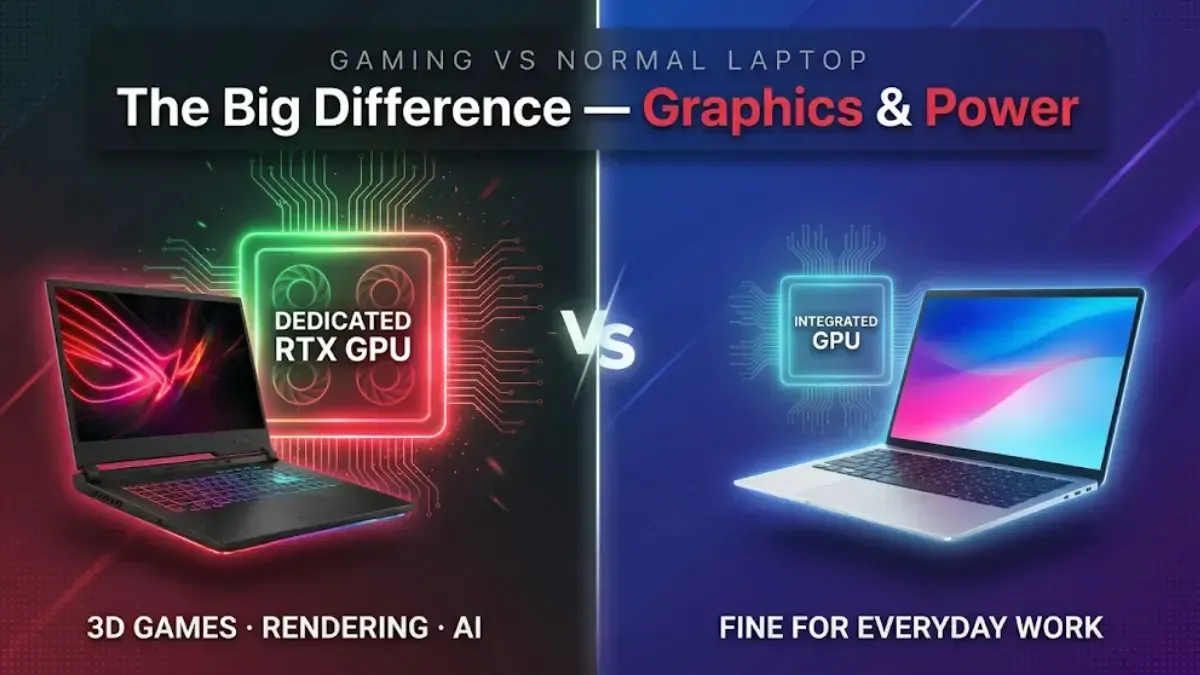
This is the biggest difference between a gaming laptop and a normal laptop.
Normal Laptop:
Uses built-in graphics. Great for office work, movies, web surfing, coding, casual gaming, and light editing. Not so good with newer games and 3D stuff.
Gaming Laptop:
Powered by a dedicated GPU like NVIDIA GeForce RTX 4050, RTX 4060, RTX 4070, or AMD Radeon series. It has separate memory and processor cores. Much faster at rendering complex visuals.
Without a dedicated graphics card, modern games and creative software just won’t run well.
3. Processor
Gaming laptops usually pack higher-performance processors like the Intel Core i7, Intel Core i9, Intel Core Ultra 7, Intel Core Ultra 9, AMD Ryzen 7, or AMD Ryzen 9.
Normal laptops typically include the Intel Core i3, Intel Core i5, Intel Core Ultra 5, AMD Ryzen 3, or AMD Ryzen 5.
For everyday work, both are excellent. For demanding workloads, gaming processors give you a clear edge.
4. RAM
8GB of RAM is the bare minimum for modern computers, and it’s becoming just that.
Recommended configurations:
8GB for casual users who browse a little and do some Office work. 16GB is good for multitasking for most buyers. 32GB for gaming, video editing, AI work, heavy multitasking.
The catch? Gaming laptops normally allow you to increase RAM relatively simply, but many tiny ultrabooks have memory soldered in place forever. Go for upgradeable RAM, and you could add years to the life of your laptop.
5. Storage
Both types now gratefully employ SSD storage.
Recommended capacities:
256GB for daily use and light files. 512GB is enough for most, comfortable for daily work. 1TB for gamers and producers. Game libraries get big fast. Gaming libraries can easily exceed hundreds of gigabytes, so larger SSDs are almost essential if you go that route.
6. Display Quality
Gaming laptops usually include:
144Hz or 165Hz refresh rates that look smooth as butter, higher brightness, better color accuracy, and faster response times that are great for fast-paced games.
Normal laptops generally offer:
60Hz refresh rate, Full HD resolution, IPS displays with good color, and lower power consumption for better battery life.
If you don’t play games, a quality Full HD IPS display is perfectly sufficient.
7. Battery Life
This is one of the biggest advantages normal laptops have.
A regular laptop can often last 8 to 12 hours on a single charge, sometimes even longer with efficient processors.
Gaming laptops typically deliver 3 to 6 hours of regular use, and much less during gaming sessions.
That dedicated graphics card consumes serious power. If long battery life matters to you, normal laptops are the clear winner.
8. Portability
Normal laptops are designed to travel.
Typical weight is 1.2 to 1.8 kilograms, which is easy to carry anywhere.
Gaming laptops often weigh 2.2 to 3 kilograms, plus you have to carry a chunky power adapter.
Their larger cooling systems, GPUs, and power supplies add serious weight. Students and frequent travelers usually appreciate lighter machines.
9. Cooling System
Gaming produces heat. Rendering, AI workloads, and 3D applications too.
Gaming laptops include larger fans, more heat pipes, greater airflow and thermal management, and more aggressive cooling for sustained loads.
Regular laptops have simpler cooling because they generate less heat.
A good cooling system helps maintain consistent performance during long workloads no throttling when you need it most.
10. Noise
Gaming laptops can get surprisingly loud under heavy load.
Fan noise kicks in while gaming, rendering, or compiling large projects. It’s not annoying exactly; it’s just the sound of the machine doing its job.
Regular laptops stay much quieter because they generate less heat.
If you work in meetings, libraries, or classrooms, quieter operation makes a real impact.
11. Price Comparison
"Let's speak about money because money is generally the decisive factor.
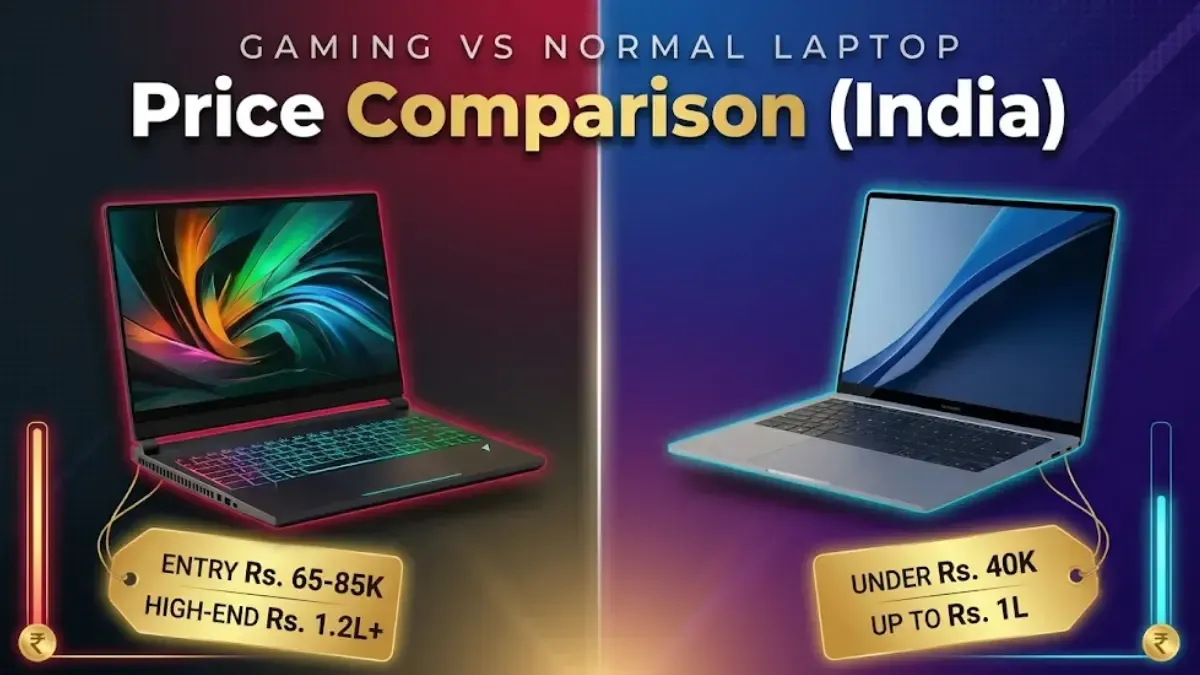
General price ranges in India:
Laptop Type
Typical Price Range
Entry-level Normal Laptop
Under Rs. 40,000
Mid-range Normal Laptop
Rs. 40,000 to Rs. 70,000
Premium Normal Laptop
Rs. 70,000 to Rs. 1,00,000
Entry-level Gaming Laptop
Rs. 65,000 to Rs. 85,000
Mid-range Gaming Laptop
Rs. 85,000 to Rs. 1,20,000
High-end Gaming Laptop
Above Rs. 1,20,000
Gaming laptops cost more because they include dedicated graphics cards, larger cooling systems, higher refresh rate displays, and more powerful processors. Unless you genuinely need that hardware, spending extra may not give you any real benefit.
Advertisement
Should I Buy a Gaming Laptop?
A gaming laptop is worth buying if your work or hobbies actually require powerful hardware.
Choose a gaming laptop if you:
Play modern AAA games, stream games online, edit videos professionally, work with Adobe Premiere Pro or After Effects or DaVinci Resolve, use Blender or Maya or AutoCAD, develop AI or machine learning projects, create 3D models, frequently multitask with demanding software, or want a laptop that can handle future performance requirements.
Tons of software developers also choose gaming laptops because compiling large projects, running multiple virtual machines, and using Docker containers all benefit from the extra processing power.
If your daily tasks regularly push your computer to its limits, investing in a gaming laptop can save you serious time.
Should I Buy a Normal Laptop?
For most people, the answer is yes.
Choose a regular laptop if you mainly use it for:
Office work and business tasks, college assignments and research, online classes and virtual lectures, programming and coding (web dev, basic app dev), internet browsing and emails, video conferencing, watching movies and streaming, managing business tasks, and casual photo editing.
Modern processors like the Intel Core i5, Intel Core Ultra 5, and AMD Ryzen 5 deliver excellent performance for these activities without requiring expensive dedicated graphics.
A lighter laptop with longer battery life is often more practical than carrying extra hardware you’ll rarely use.
Good performance overall. Powerful dedicated graphics card. Better multitasking capabilities. Render video faster. High refresh rate display. Simpler RAM & storage upgrades. Improved cooling systems. Excellent for creative professionals. User-friendly demanding software. Future-proofed for high-performance workloads.
Cons:
Higher price tag, shorter battery life, heavier and bulkier, louder cooling fans, generates more heat, larger power adapter to carry around, and not ideal for frequent travel.
Many buyers purchase gaming laptops simply because they seem more powerful, only to realize later that they mostly browse the web and use Microsoft Office. In that case, much of that extra hardware just sits unused.
Normal Laptop Advantages and Disadvantages
Pros:
Usually cheaper. Longer battery life. Portable and lightweight. Quiet. Easier to carry around daily. Less power consumption. Best for students and professionals. Comes in many designs.
Cons:
Not suitable for heavy rendering or AI tasks. Not as well suited for professional creative work. Limited gaming performance. Integrated graphics are not up to the task of high-demand games. Less upgradeability in some thin models. Basic cooling systems.
These drawbacks only matter if your work actually requires high-performance hardware.
Gaming Laptop vs Normal Laptop Performance: Which Is Better?
If you’re comparing normal laptop vs gaming laptop performance, the gaming machine wins no contest.
But here’s the thing: performance isn’t everything.
If all you do is browse, stream, and work on documents, a normal laptop’s performance is more than enough. You won’t notice the difference because you won’t be pushing the machine to its limits.
The question isn’t which one performs better; it’s which one performs better for you.
Upgrading Your Laptop? Here’s a smart tip.
If you’re planning to replace your current laptop, don’t let the old one sit unused in a drawer.
Selling your existing laptop can significantly reduce the cost of upgrading. Before buying a new device, it’s worth checking your old laptop’s resale value. Platforms like Cashkr let you estimate its value online quickly and easily, so you can put that money toward your new purchase instead of letting it gather dust.
Final Verdict
There’s not a clear victor when it comes to gaming laptop or conventional laptop. The best one is totally up to you.
Students, professionals, business users, and anyone who values portability, long battery life, and price will find a regular laptop ideal. It is lightweight and efficient, and it does routine duties pleasantly.
A gaming laptop is for when you need the absolute most performance. If you’re gaming, editing films, making 3D models, developing AI applications, or working with demanding software, the added processing power, dedicated graphics card, and superior cooling system make a difference you can feel.
Don’t just get the most powerful laptop you can afford; buy the one that’s right for your everyday workflow. You save money, have a better user experience, and don’t pay for gear you may never fully utilize.
Bottom Line: If your work includes studying, office work, web browsing, entertainment, and general productivity, then a regular laptop will suffice. It’s quieter, cheaper, lighter, and has a good battery life. If you are a regular player of modern games, edit movies, work with creative applications, develop AI projects, or require workstation-level performance, opt for a gaming laptop. It costs more and uses more power, but the performance boost can be quite worthwhile.
FAQs
1. What is the difference between a gaming laptop and a normal laptop?
The graphics card is the main difference. Gaming laptops have dedicated graphics cards, better cooling, and more powerful technology. Regular laptops are focused on portability, battery life, and everyday performance.
2. Is a gaming laptop good for everyday use?
Yes. A gaming laptop can easily handle browsing, office work, streaming, and video calls. However, it is generally heavier, louder, and has shorter battery life than a normal laptop.
3. Can I use a gaming laptop for office work?
Of course. Gaming laptops can easily run office apps. But for many users, a lighter business laptop would be more comfortable for everyday commuting.
4. Are gaming laptops worth buying?
They are worth buying if you play modern games or use demanding software such as video editors, CAD tools, AI applications, or 3D rendering software.
5. Can a normal laptop run games?
Yes, but only light or less demanding games. Modern AAA games generally require a dedicated graphics card for smooth performance.
6. Which laptop is better for students?
Most students are better off with a normal laptop. Students studying animation, architecture, engineering, or game development may benefit from a gaming laptop.
7. Do gaming laptops last longer?
Gaming laptops frequently have more powerful technology, but how long they last depends on how well you maintain, cool, and use them. Either type of good laptop will last you many years.
8. Is a gaming laptop good for programming?
Yes. Gaming laptops are excellent for programming, especially if you work with virtual machines, Android development, AI projects, or large software builds.
9. Why are gaming laptops more expensive?
High-end CPUs, dedicated graphics cards, advanced cooling systems, high-quality displays, and upgradeable components all contribute to the expense of creating them.
10. Should I buy a gaming laptop even if I don’t play games?
Only if your job requires high-performance gear. Otherwise, a typical laptop will often offer superior value, longer battery life and greater portability.