Google Pixel 11 Leak: What the CAD Renders Tell Us and What to Actually Expect
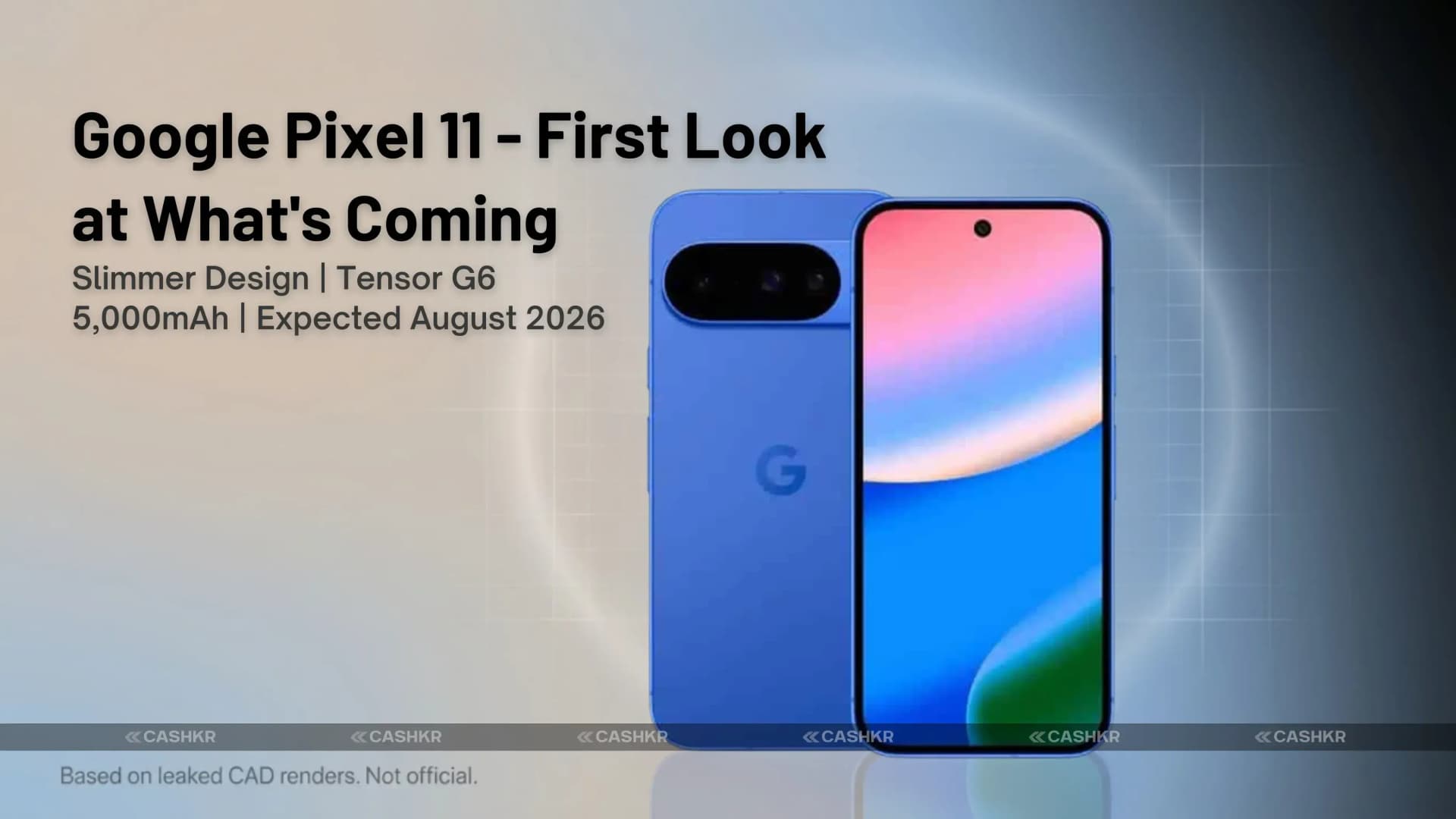
Google's Pixel 11 has leaked through CAD renders, and the picture is becoming clearer ahead of an expected August 2026 launch.
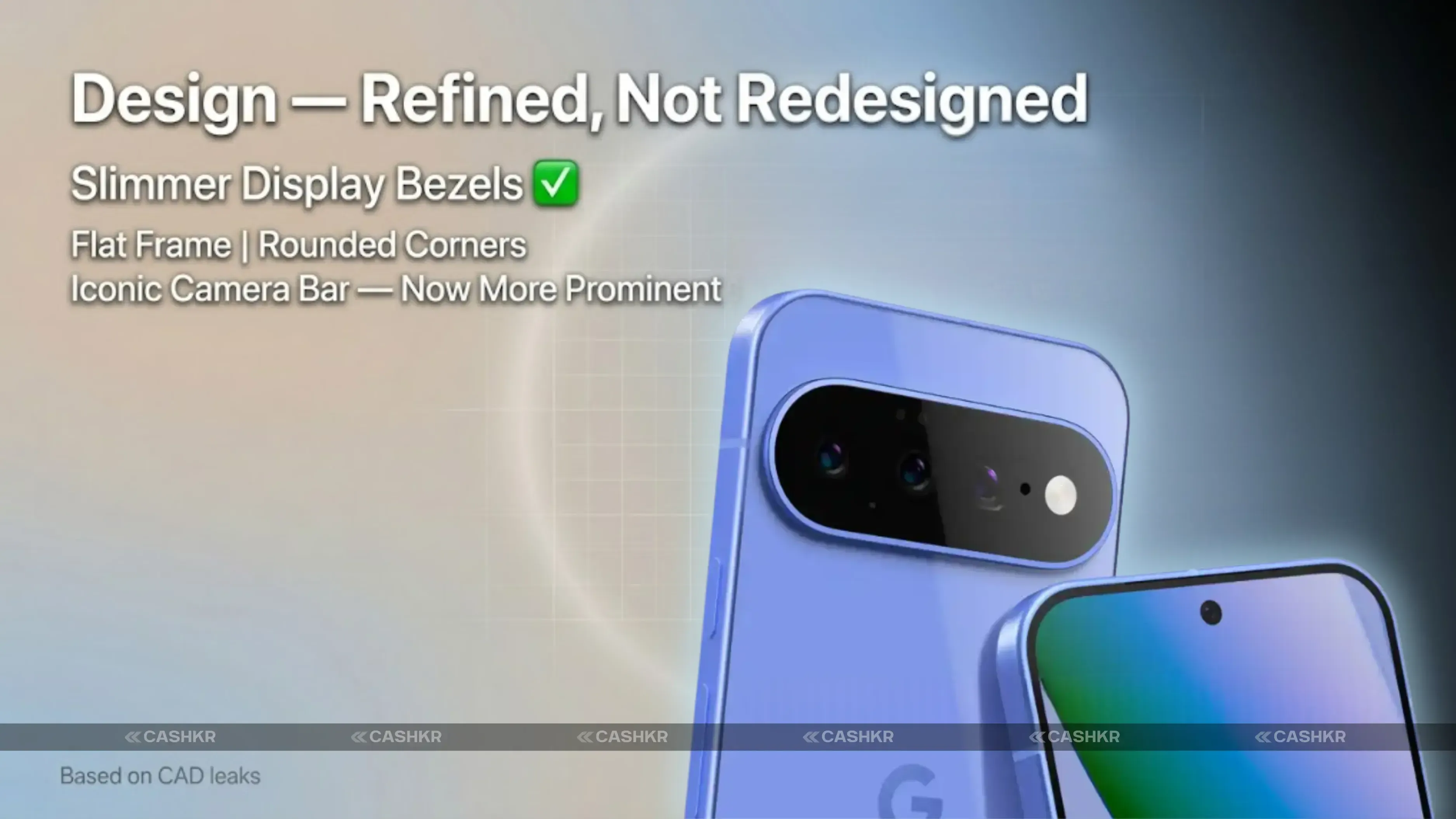
The design is familiar. The camera bar stays. The flat frame stays. The overall silhouette is recognizably Pixel. But the details show meaningful refinements: slimmer bezels that the Pixel 10 was criticized for, a more prominent camera bar finish, and a slightly thinner 8.5mm profile across dimensions of 152.8 by 72mm.
Under the surface, the Tensor G6 chipset and a reported switch to a MediaTek M90 modem are the most significant hardware stories. The battery steps up from 4,700 mAh to a reported 5,000 mAh. And the 6.3-inch LTPO AMOLED display adds adaptive refresh rate scaling, unlike the standard OLED on the Pixel 10.
This is a refinement cycle, not a reinvention. Here is everything leaked so far and what it means for buyers.
What is confirmed via leaks: Slimmer bezels confirmed via CAD renders | Dimensions 152.8 x 72 x 8.5mm | Camera bar with more prominent black finish | Power button above volume rocker | What is expected but unconfirmed: Tensor G6, 5,000mAh battery, MediaTek M90 modem, 12GB RAM, August 2026 launch
Design Leak: What the CAD Renders Show
CAD renders are among the most reliable early leak sources for smartphones because case manufacturers use them to prepare accessories before launch. The Pixel 11 CAD renders that have surfaced show a phone that is unmistakably Pixel in design language.
The full-width camera bar across the back remains. Google has used this design element since the Pixel 6, and it has become a distinctive Pixel identifier. On the Pixel 11, the camera bar gets a more prominent black finish that visually separates it from the back panel rather than blending into it. This is a subtle but visible change that gives the back design more intentional contrast.
The front bezels are where the most meaningful design improvement shows up. The Pixel 10 was criticized for its noticeably wider bezels compared to competing flagships at similar prices. The leaked renders show slimmer bezels on all four sides of the Pixel 11, bringing it closer to the narrow-bezel standard set by Samsung's Galaxy S25 series and Apple's iPhone 16.
The flat frame with rounded corners continues from the Pixel 10. The power button sits above the volume rocker on the right side. At 152.8 by 72 by 8.5mm, the Pixel 11 is almost identical in footprint to the Pixel 10 while being slightly thinner. The form factor hasn't changed much, but the refinements are in the right places.
Why CAD renders are reliable: Case manufacturers need accurate dimensions months before a phone launches to have products ready at announcement. Leaked CAD files from accessory supply chains represent actual engineering measurements rather than speculation. The dimensions and button placement shown in these renders are highly likely to match the final product.
Advertisement
Dimensions
152.8 x 72 x 8.5mm (from CAD leak)
Frame
Flat, rounded corners
Camera Bar
Full-width, more prominent black finish
Bezels
Slimmer than Pixel 10 (confirmed via renders)
Button Layout
Power above volume, right side
Design Status
Confirmed via CAD renders
Display: LTPO AMOLED Adds Adaptive Refresh Rate
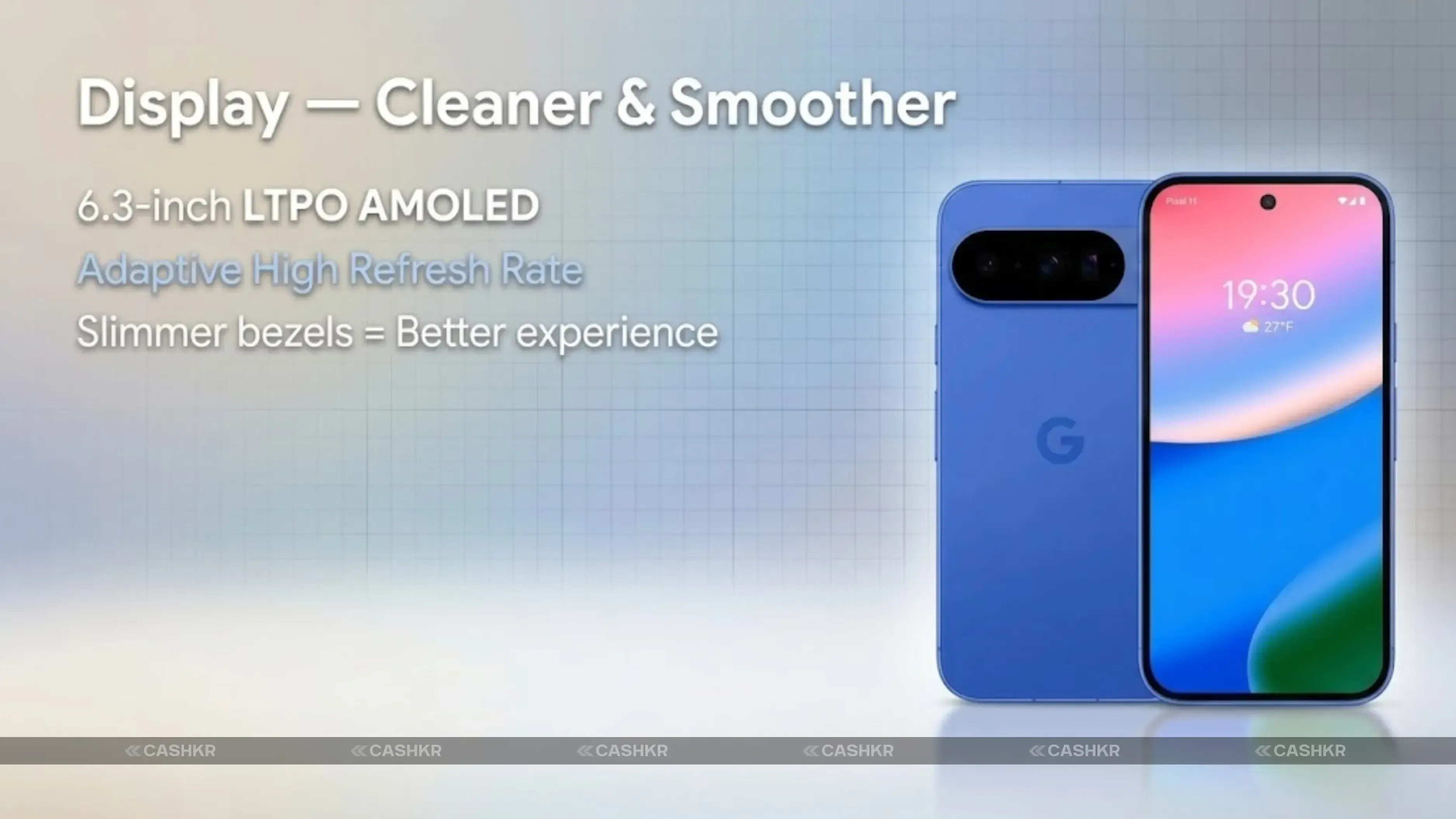
The Pixel 11 is expected to feature a 6.3-inch LTPO AMOLED display, which is an upgrade over the standard OLED on the Pixel 10.
The difference between standard OLED and LTPO AMOLED is the adaptive refresh rate capability. Standard OLEDs run at a fixed refresh rate, typically 90Hz or 120Hz, regardless of what is on screen. LTPO AMOLED can intelligently scale the refresh rate from as low as 1Hz when the screen is showing static content up to 120Hz during fast scrolling and gaming.
In practice, this adaptive scaling does two things. First, it makes the display smoother in use because the refresh rate climbs to 120Hz for any fast-moving content. Second, it improves battery efficiency because the display drops to much lower refresh rates when showing a still image, reading an article, or displaying a notification screen. For a phone with AI features that frequently keep the display active in ambient modes, this efficiency improvement directly affects battery life.
The 6.3-inch size remains the same as the Pixel 10, keeping the Pixel 11 in the compact flagship category that has been a Pixel design identity. This contrasts with Samsung and Apple flagships, which have grown to 6.7 to 6.9 inches. For buyers who specifically want a powerful phone that is comfortable in one hand, the 6.3-inch Pixel form factor remains one of the few options in 2026.
LTPO upgrade significance: The Pixel 10's standard 90Hz OLED was a weak point compared to flagship competitors using LTPO at similar prices. The Pixel 11's reported LTPO AMOLED addresses this gap and aligns it with the Galaxy S25 and iPhone 16 Pro displays in terms of the adaptive refresh feature set.
Display Type
6.3-inch LTPO AMOLED (expected)
Refresh Rate
Adaptive, 1Hz to 120Hz (expected)
Improvement
Adaptive refresh over Pixel 10's standard OLED
Tensor G6: What to Expect From Google's Next Custom Chip
The Tensor G6 is expected to power the Pixel 11, arriving at a critical moment for Google's custom silicon strategy.
The Tensor G5 in the Pixel 10 received mixed reviews. Its AI performance was strong, particularly for on-device tasks such as live translation, call screening, and AI photo processing. Its raw CPU performance was lower than that of Qualcomm's Snapdragon 8 Elite and Apple's A18. Thermal management under sustained load was also a consistent criticism.
The Tensor G6 is expected to address these weaknesses. The reported 7-core CPU architecture is designed to deliver better sustained performance without the throttling that affected the G5 during prolonged gaming or intensive app use. Google's partnership with Samsung for Tensor chip manufacturing continues, but the architectural improvements in the G6 are designed to close the raw performance gap with Qualcomm.
Where Tensor chips have always led is on-device AI. Google's entire AI feature stack, including Magic Eraser, Photo Unblur, Call Screen, Direct My Call, and the Pixel-exclusive Gemini Nano integration, runs more efficiently on Tensor than on third-party chipsets. For users who use these AI features daily, Tensor's advantage in AI task speed and accuracy is a genuine differentiator that benchmark scores do not fully capture.
The reported switch to a MediaTek M90 modem is a significant connectivity upgrade. Previous Tensor generations used Samsung's modem, which received criticism for suboptimal 5G connectivity and millimeter-wave performance. The MediaTek M90 is a proven modem used in high-end devices with stronger real-world connectivity results.
Chipset
Google Tensor G6 (expected)
CPU
7-core architecture (expected)
RAM
12GB (expected)
Modem
MediaTek M90 (reported)
AI Strength
On-device Gemini Nano, Magic Eraser, Call Screen
Storage
128GB starting (expected)
Tensor vs Snapdragon for Pixel buyers: If raw gaming benchmark performance is your priority, Snapdragon alternatives win. If AI features like live translation, Call Screen, Photo Unblur, and Gemini Nano are daily tools you rely on, Tensor delivers these faster and more accurately than any alternative.
Battery: 5,000mAh Is the Right Move
The Pixel line has historically had smaller batteries than competing flagships. The Pixel 10 at 4,700mAh was already a step up from previous generations. The Pixel 11, with a reported 5,000 mAh, continues that positive trend.
5,000 mAh is the standard most Android flagships in 2026 have reached. Getting the Pixel 11 to this capacity, alongside the more efficient LTPO AMOLED display and the improved Tensor G6 chip, means battery life should be a strength of the Pixel 11 rather than a common criticism, as it was in older Pixel generations.
Google's power management software is a genuine advantage. Adaptive Battery on Pixel phones learns which apps you use and reduces background power consumption from apps you rarely interact with. Combined with 5,000mAh of physical capacity and LTPO display efficiency, the Pixel 11 should comfortably provide all-day battery life under typical use.
Charging speeds for the Pixel 11 have not been leaked yet. The Pixel 10 supported 30W wired charging, which is below the 45W to 80W speeds offered by Samsung and OnePlus at comparable prices. If Google does not improve charging speed on the Pixel 11, this will remain the most legitimate battery-related criticism.
Charging speed gap: Google's 30W wired charging on the Pixel 10 was slower than competing flagships. If the Pixel 11 stays at 30W, filling a 5,000mAh battery will take approximately 1 hour 40 minutes to 2 hours, which is slower than the Samsung Galaxy S25's 45W and the OnePlus 13's 100W. Watch for official confirmation at launch.
Battery
5,000mAh (expected, up from 4,700mAh)
Wired Charging
Not confirmed, likely 30W based on previous generation
Power Software
Adaptive Battery, Gemini Nano power management
Google Pixel 11 Expected Price and Launch Timeline
The Pixel 11 is expected to launch in August 2026, consistent with Google's annual Pixel release schedule, which targets the August to October window each year.
The expected starting price is approximately USD 799, which converts to around Rs. 75,200 at current exchange rates. The actual India launch price will likely be higher due to import duties and local taxes, as with the Pixel 10's India pricing, which differed from the direct USD conversion.
The August launch timing places the Pixel 11 after Samsung's Galaxy Z Fold and Z Flip foldable announcement and well ahead of Apple's iPhone 17 launch. This positioning gives the Pixel 11 a window as the freshest flagship Android announcement before attention shifts to Apple's launch event.
India's availability for Pixel phones has improved significantly with recent generations. Flipkart has been the primary Indian channel for Pixel phones, with bank offers and exchange bonuses commonly available at launch.
Expected Launch
August 2026
Expected Price
USD 799 (~Rs. 75,200 at current rates)
India Launch
Expected alongside or shortly after global launch
India Channel
Flipkart (based on previous Pixel launches)
Launch Timing
After Samsung Z series, before iPhone 17
Pixel 10 vs Pixel 11: What Actually Changed
Chipset
Tensor G6 (expected)
Tensor G5
RAM
12GB (expected)
12GB
Battery
5,000mAh (expected)
4,700mAh
Modem
MediaTek M90 (expected)
Previous gen modem
Display
6.3-inch LTPO AMOLED
6.3-inch OLED
Bezels
Slimmer (CAD leak confirmed)
Wider
Dimensions
The most meaningful changes are the LTPO display upgrade, the 300mAh battery increase, the slimmer bezels, and the expected MediaTek M90 modem. The Tensor G6 performance improvement over G5 will be the most closely watched upgrade when benchmark results emerge after launch.
Should You Wait for the Pixel 11?
Wait for the Pixel 11 if you are a current Pixel 9 or older user. The combination of Tensor G6, LTPO display, slimmer bezels, and a larger battery represents a meaningful generational leap from two generations ago.
Wait for the Pixel 11 if you specifically want Google's AI features. Call Screen, Magic Eraser, Photo Unblur, and Gemini Nano are Pixel exclusive or Pixel best-in-class. The Tensor G6 will run these faster and more efficiently than the G5.
Consider buying the Pixel 10 now if the price drops meaningfully at the Pixel 11 launch. Pixel 10 prices typically fall after the new model launches, making it a good value proposition if you do not need the latest chip.
Look elsewhere if raw processing performance or the fastest charging are priorities. The Samsung Galaxy S25 and OnePlus 13 offer higher benchmark performance and faster charging at comparable prices.
Wait for Pixel 12 if you want a major redesign. The Pixel 11 is a refinement of the Pixel 10. Google's significant redesigns tend to happen every other generation.
Final Verdict
The Google Pixel 11 is shaping up to be the refinement upgrade Pixel fans have been waiting for after a generation.
Slimmer bezels address the Pixel 10's most visible criticism. The LTPO AMOLED display upgrade adds adaptive refresh that should improve both smoothness and battery life. The 5,000 mAh battery meets the capacity standard that flagships in 2026 are expected to meet. The MediaTek M90 modem upgrade, if confirmed, addresses one of the most consistent connectivity criticisms of the Tensor generation.
The Tensor G6's actual performance improvement over G5 will be the defining question answered at launch. If Google has closed the gap with Snapdragon on sustained CPU performance and thermal management, the Pixel 11 will be the most complete Pixel flagship to date. If the gap remains large, the Pixel 11 remains the right phone specifically for buyers who prioritize Google's AI features and software experience over raw performance.
August 2026 is when the full picture becomes clear. Based on leaks and reports, the Pixel 11 will be worth the wait for Pixel fans and serious consideration for buyers in the Rs. 70,000 to Rs. 85,000 flagship range.
Bottom Line: Slimmer bezels, LTPO AMOLED, Tensor G6, 5,000mAh battery, and MediaTek M90 modem make the Pixel 11 the most complete Pixel upgrade in several generations. Expected August 2026 at ~Rs. 75,200. Worth waiting for if Google AI features are part of your daily workflow.
FAQs
1. When will the Google Pixel 11 launch?
The Pixel 11 is expected to launch in August 2026, consistent with Google's annual Pixel release schedule. No official date has been confirmed yet.
2. What is the expected price of the Google Pixel 11 in India?
Based on the expected USD 799 global price, the approximate India equivalent is around Rs. 75,200 at current exchange rates. Actual India pricing will likely be higher due to import duties and taxes. Watch for official Google India pricing at launch.
3. What chipset does the Google Pixel 11 have?
The Pixel 11 is expected to run on the Google Tensor G6, a 7-core CPU chipset designed for improved AI processing and better sustained performance compared to the Tensor G5.
4. What are the leaked design changes on the Pixel 11?
Leaked CAD renders confirm slimmer bezels on all sides, a camera bar with a more prominent black finish, a flat frame with rounded corners, and dimensions of 152.8 by 72 by 8.5mm. The overall design is a refined evolution of the Pixel 10.
5. Does the Google Pixel 11 have a better display than the Pixel 10?
Yes, if the leaks are accurate. The Pixel 11 is expected to use an LTPO AMOLED display with adaptive refresh from 1Hz to 120Hz, compared to the Pixel 10's standard OLED. This brings smoother scrolling and better power efficiency.
6. What is the Google Pixel 11 battery capacity?
The Pixel 11 is tipped to have a 5,000mAh battery, up from the 4,700mAh in the Pixel 10. This is the standard capacity for flagship phones in 2026 and should provide comfortable all-day battery life.
7. What is the MediaTek M90 modem in the Pixel 11?
Reports suggest the Pixel 11 will switch from Samsung's modem in previous Tensor chips to a MediaTek M90 modem. The M90 is a high-performance modem with strong real-world 5G connectivity results, addressing criticism of the previous Tensor generation's modem performance.
8. Should I upgrade from Pixel 10 to Pixel 11?
If you are on the Pixel 10, the upgrade is incremental rather than essential. Slimmer bezels, LTPO display, and slightly larger battery are meaningful but not dramatic changes. If you are on Pixel 9 or older, the Pixel 11 represents a more compelling generational jump.
9. How does the Google Pixel 11 compare to the Samsung Galaxy S25?
The Samsung Galaxy S25 has faster raw Snapdragon 8 Elite performance and 45W charging. The Pixel 11 will have Google's AI features like Call Screen and Magic Eraser that run on Tensor, as well as pure Android with guaranteed long-term updates. Both are strong flagships for different buyers.
10. Is the Google Pixel 11 camera an upgrade over the Pixel 10?
Camera specifications for the Pixel 11 have not yet appeared in leaks. Google's camera improvements typically come from computational photography and AI processing enhancements on the Tensor chip rather than hardware changes. Full camera details will be revealed at the official launch.
If you want to sell your old devices, then click here.
 Yaskar Jung ShahUpdated: Aug 10, 2026·16 min read