Asus Pad Unveiled at Computex 2026: 2.8K OLED Display and Full Specifications
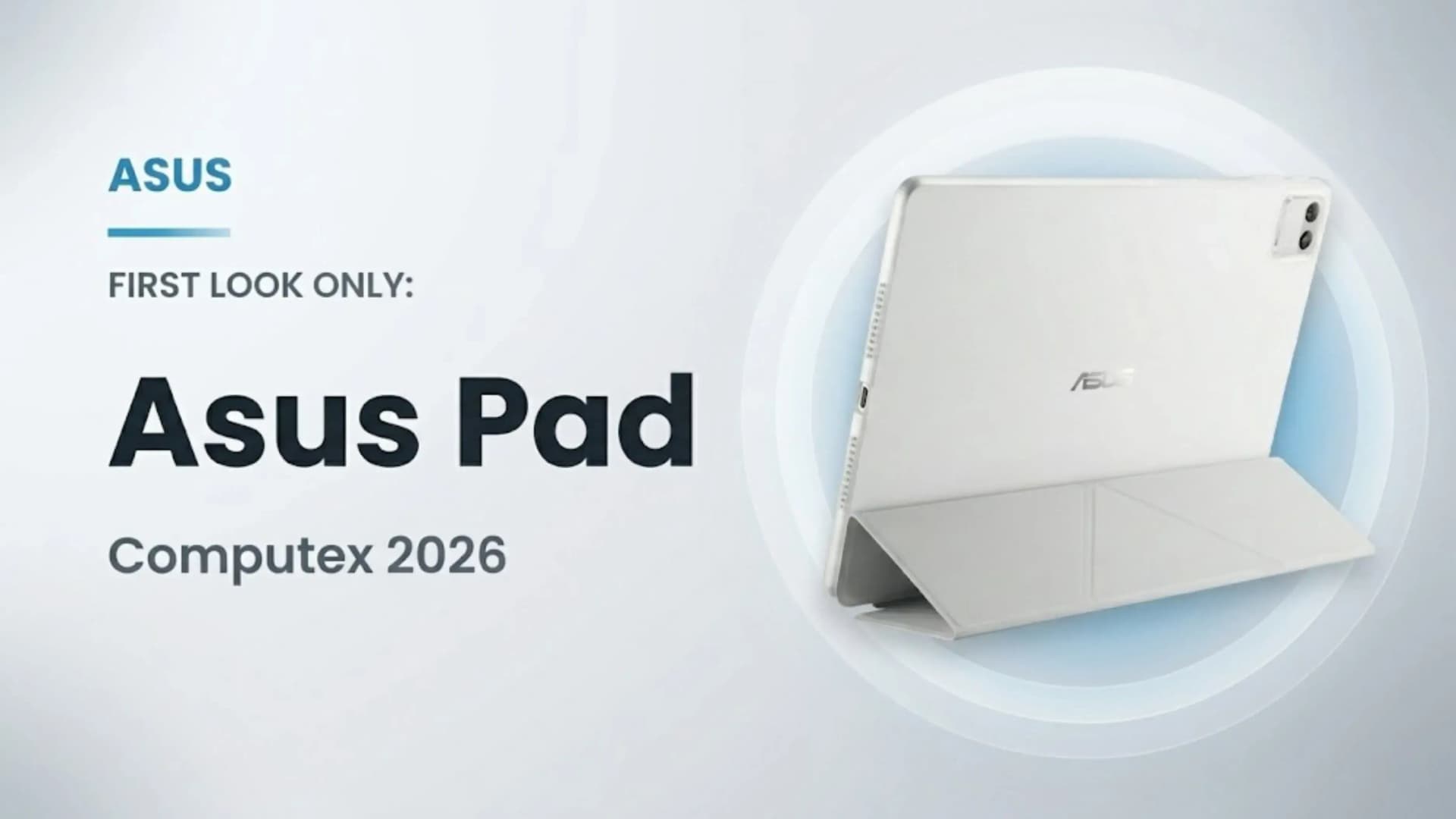
Asus is back in the Android tablet market with the new Asus Pad, introduced at Computex 2026. It features a 12.2-inch 2.8K dual-layer OLED display running at 144Hz with a 3:2 aspect ratio, a MediaTek Dimensity 8300 processor, a 9,000mAh battery with 45W fast charging, support for a stylus and keyboard, and runs Android 16. This launch marks Asus's return to the premium Android tablet space, putting it in direct competition with the OnePlus Pad 4 and Samsung Galaxy Tab series.
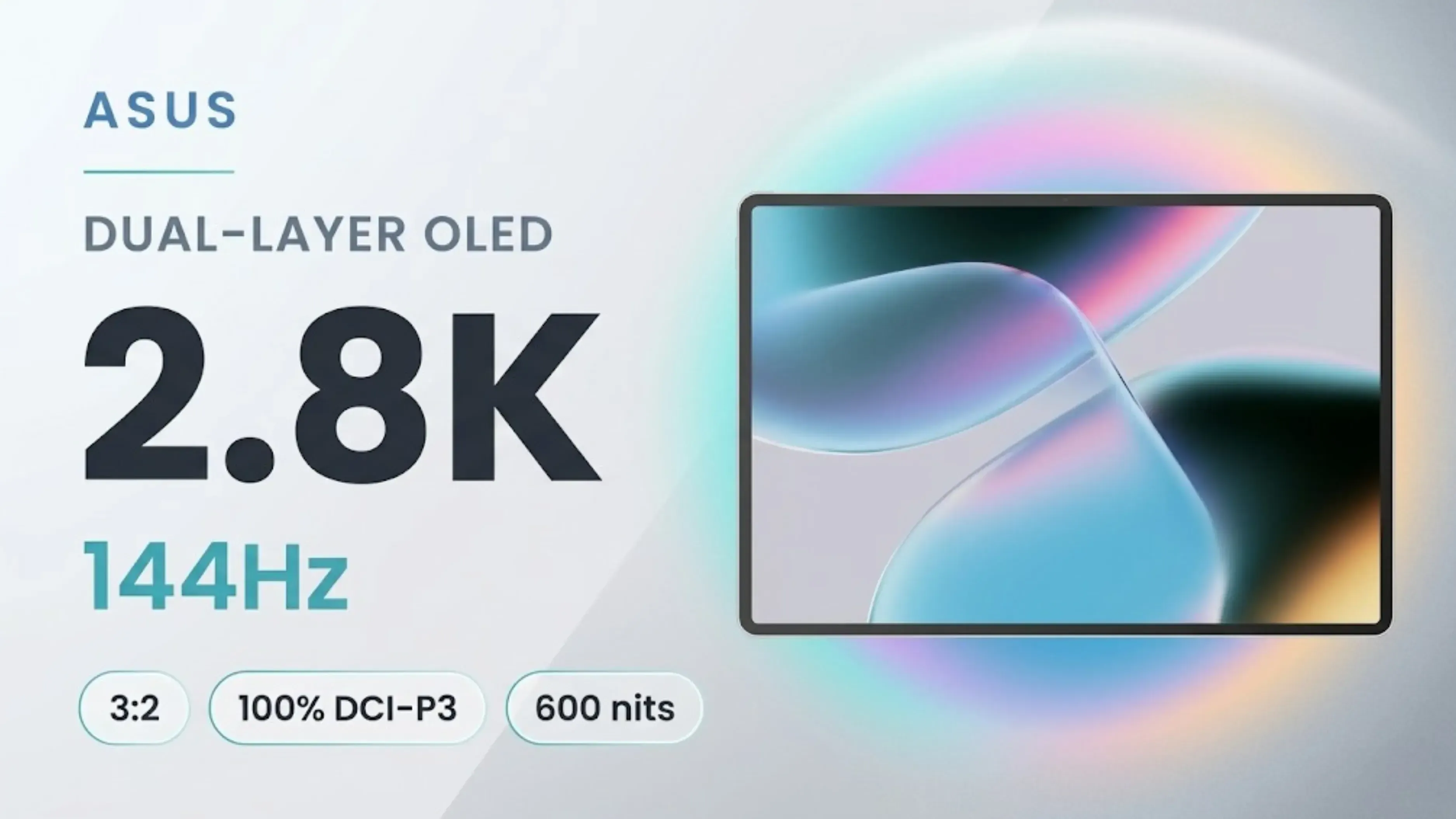
The standout feature of the Asus Pad is its dual-layer OLED display. While regular OLED screens use a single light-emitting layer, this one uses two, which roughly doubles the brightness at the same power or maintains the same brightness with less power for better battery life. With its 2.8K resolution, 144Hz refresh rate, 3:2 aspect ratio, and full DCI-P3 color coverage, the Asus Pad offers one of the best displays in its price range.
Asus has not yet announced the price or regional availability for the Asus Pad. The company says more details about where and when it will launch are coming soon. Below are the confirmed specs and what they mean for everyday use.
Asus Pad specs at Computex 2026: 12.2-inch 2.8K (2,800x1,840) dual-layer OLED 144Hz 3:2 100% DCI-P3 600 nits TÜV Rheinland | Dimensity 8300 + 8GB LPDDR5X | Up to 256GB UFS 3.1 + microSD 1TB | Android 16 + Google Gemini + Circle to Search | 13MP rear + 5MP front | Quad speakers Dolby Atmos | 9,000mAh + 45W (50% in 30 min) | Wi-Fi 6E + Bluetooth 5.3 | Asus Pen 2.0 + Bluetooth keyboard support | 271.1x182.4x6.5mm | 523g | Price TBC | India TBC
Asus Pad Display: Dual-Layer OLED at 2.8K and 144Hz
The Asus Pad comes with a 12.2-inch 2.8K OLED display (2800 x 1840 pixels), a 144Hz refresh rate, a 3:2 aspect ratio, and dual-layer OLED technology. The 3:2 aspect ratio is taller than the 16:10 ratio found on most other Android tablets. This taller screen gives you more vertical space for reading, browsing, and working in split-screen, making it especially useful for productivity tasks where vertical space matters more than width.
The dual-layer OLED is the main highlight of the Asus Pad's display. Regular OLED tablets use one light-emitting layer per pixel, but this design adds a second layer, nearly doubling the brightness for the same screen size. This means you get higher peak brightness without using more power, or the same brightness while saving battery. Asus says the display can reach up to 600 nits of brightness. While that's less than some top smartphones, it's still bright enough for most indoor settings.
The Asus Pad's TÜV Rheinland certification means it reduces blue light and flicker, making it easier on your eyes during long use. This is important for people who read, take notes, or work on documents for hours at a time, since flicker and blue light can cause eye strain. Full DCI-P3 color coverage also ensures accurate colors for creative work, photo editing, and watching HDR videos.
Why is 3:2 better than 16:10 for productivity? Most tablets use a 16:10 aspect ratio, which is wider and better for watching videos. The 3:2 ratio is closer to the shape of A4 paper and gives you more vertical space at the same width. This means you can see more of your documents, notes, or apps like Google Docs and Sheets without needing to scroll as much compared to a 16:10 tablet of the same size.
Dual-layer OLED vs standard OLED: A regular OLED screen uses one light-emitting layer per pixel. A dual-layer OLED stack uses two layers, so it can get brighter without putting as much strain on each layer. This helps the screen keep its brightness longer and reduces wear over time. It's especially useful for using the tablet outdoors or in bright offices.
Asus Pad Processor and Software: Dimensity 8300 and Android 16
The Asus Pad runs on the MediaTek Dimensity 8300, a strong mid-range processor that can handle multitasking, gaming, and the AI features in Android 16. It comes with 8GB of fast LPDDR5X RAM and up to 256GB of UFS 3.1 storage, plus a microSD slot for up to 1TB of extra space. The LPDDR5X RAM is the latest standard, delivering higher speeds for multitasking, large documents, and games.
The Asus Pad runs Android 16 and includes Google Gemini, Circle to Search, and Asus GlideX. Google Gemini brings AI features like text summarizing, writing help, and content analysis right on the tablet. With Circle to Search, you can draw a circle around anything on your screen to search for it on Google, which is handy for research. Asus GlideX lets you share your screen, transfer files, and use your mouse and keyboard across the Asus Pad and other Asus devices, such as ROG and ZenBook laptops or Zenfone phones.
Dimensity 8300 vs Dimensity 9400: The Asus Pad uses the Dimensity 8300, which is a step below the Dimensity 9400 found in the OnePlus Pad 4 and the Snapdragon 8 Elite in top-tier tablets. The Dimensity 8300 is more than enough for productivity. If you want to play games at the highest settings for long periods, you might prefer the OnePlus Pad 4's faster chip, but the Asus Pad offers a better OLED display.
Asus Pad Battery: 9,000mAh With 45W Charging
The Asus Pad has a 9,000mAh battery and supports 45W USB-C fast charging. According to Asus, you can charge it to 50 percent in about 30 minutes, which is enough for several hours of use. A full charge takes around 90 to 100 minutes. For a 12.2-inch tablet, this battery should easily last a full workday and into the evening for media use without needing another charge.
The dual-layer OLED display uses less power at high brightness, so watching videos with a bright screen drains the battery less than on a standard OLED. The Dimensity 8300 chip is also efficient, helping the Asus Pad last longer during heavy use. Together, these features mean the 9,000mAh battery should last a full day of heavy use or up to two days with lighter use.
Comparing batteries: The OnePlus Pad 4 (Rs. 37,999) has a 13,380mAh battery, while the Asus Pad has a 9,000mAh battery. However, the OnePlus Pad 4 is bigger at 13.2 inches, so its battery has to power a larger screen. Smaller tablets like the Asus Pad can still match larger ones in battery life per session. For its 12.2-inch size, the Asus Pad's 9,000mAh battery is well-matched to its needs.
Accessories: Asus Pen 2.0, Bluetooth Keyboard and Protective Case
The Asus Pad supports the Asus Pen 2.0 stylus and Bluetooth keyboards, and comes with a protective case in the box. The Asus Pen 2.0 is the latest version of Asus's stylus, designed for handwriting, sketching, and note-taking. Details like pressure sensitivity, tilt support, and latency haven't been shared yet and will be announced at the regional launch.
With Bluetooth keyboard support, the Asus Pad can work as a laptop replacement for travel and light work. The 3:2 aspect ratio and stylus make it good for taking notes, creating documents, creative projects, and reading—all in one portable device. Pricing and details about the accessories, including whether the keyboard connects wirelessly or attaches as a cover, will be announced at the regional launch. This will be important for people who use keyboards often.
Asus Pad vs OnePlus Pad 4 and Samsung Galaxy Tab A9+
Although the Asus Pad's price hasn't been announced yet, here's how it stacks up against its main Android tablet competitors in India:
Feature
Asus Pad
OnePlus Pad 4
Samsung Tab A9+
Price
TBC
Rs. 59,999
Rs. 24,999
Display
12.2-inch 2.8K OLED, 144Hz
13.2-inch 3.4K IPS, 144Hz
10.5-inch TFT LCD, 90Hz
Aspect Ratio
3:2
7:5
16:10
Chipset
Dimensity 8300
Dimensity 9400
Exynos 1380
RAM
8GB LPDDR5X
12GB
8GB
Storage
Up to 256GB + microSD (1TB)
256GB
128GB + microSD
Battery
9,000mAh
13,380mAh
8,000mAh
Charging
45W
Not specified
45W
Display Technology
Dual-layer OLED
IPS LCD
TFT LCD
Stylus Support
Asus Pen 2.0
Stylo Pro Stylus
No
Keyboard Support
Yes
Yes
No
Wi-Fi
Wi-Fi 6E
Wi-Fi 6E
Wi-Fi 5
Software
Android 16
Android 16
Android 15
The Asus Pad stands out for its display: it uses a dual-layer OLED, while the OnePlus Pad 4 has an IPS LCD and the Samsung Tab A9 Plus uses a TFT LCD. OLED screens offer better contrast, richer colors, and use less power at lower brightness, which is great for both media and work. The 3:2 aspect ratio is also a unique productivity feature. Support for the Asus Pen 2.0 and microSD expansion up to 1TB are other practical benefits.
The Asus Pad's main drawbacks compared to its rivals are its smaller 9,000mAh battery (versus the OnePlus Pad 4's 13,380mAh), a less powerful Dimensity 8300 chip, and the fact that its price is still unknown. If Asus launches it in India at or below Rs. 35,000, its OLED display makes it a top pick for those who care about screen quality. But if the price is much higher, the OnePlus Pad 4's bigger battery, faster chip, and confirmed availability make it a better choice.
Choose the Asus Pad if you want a high-quality OLED display, a 3:2 aspect ratio for productivity, stylus and keyboard support, and microSD expansion—especially if the launch price in India is close to the OnePlus Pad 4.
Pick the OnePlus Pad 4 (Rs. 37,999) if you want a set price now, a bigger 13.2-inch screen, a larger 13,380mAh battery, and the faster Dimensity 9400 chip. Its main drawback is the IPS LCD display compared to the Asus Pad's OLED.
Go for the Samsung Galaxy Tab A9+ (Rs. 24,999) if your main concern is price. It's much cheaper than the other options, but you give up OLED display quality, top processor performance, and storage expansion in exchange for Samsung's ecosystem and about Rs. 13,000 in savings.
Final Verdict
The Asus Pad is a well-designed Android tablet that addresses common issues in productivity and creativity. It uses an OLED display instead of an LCD, has a 3:2 aspect ratio for better document work, offers official stylus support, and supports expandable storage. The dual-layer OLED is the key feature that sets the Asus Pad apart from other Android tablets in its price range.
The most important detail still missing is the Asus Pad's launch price in India. Once it's announced, buyers can compare it directly with the OnePlus Pad 4 (Rs. 37,999) and see if the better display is worth the extra cost. Keep an eye on Asus India's official channels for updates on pricing and launch dates.
Bottom Line: The Asus Pad was introduced at Computex 2026. It features a 12.2-inch 2.8K dual-layer OLED display at 144Hz with a 3:2 aspect ratio, Dimensity 8300 processor, 8GB LPDDR5X RAM, 256GB storage with microSD expansion up to 1TB, a 9,000mAh battery with 45W charging (50% in 30 minutes), Asus Pen 2.0 and Bluetooth keyboard support, Android 16 with Gemini and GlideX, quad Dolby Atmos speakers, and weighs 523g. Price and India launch details are still to be confirmed.
FAQs
1. What is the price of the Asus Pad in India?
Asus has not announced the price of the Asus Pad. Regional pricing and launch details are expected in the weeks following the Computex 2026 reveal. Watch Asus India's official channels and Flipkart or Amazon India for the price announcement in India.
Advertisement
2. What display does the Asus Pad have?
A 12.2-inch dual-layer OLED display at 2,800 by 1,840 pixels (2.8K resolution) with a 144Hz refresh rate, 3:2 aspect ratio, 100 percent DCI-P3 colour coverage, up to 600 nits peak brightness and TÜV Rheinland certification for reduced blue light and flicker-free viewing.
3. What is a dual-layer OLED and why does it matter?
A dual-layer OLED stack uses two organic light-emitting layers in the display panel, instead of the single layer used in standard OLED tablets. The second layer approximately doubles the light output capability, enabling higher peak brightness at equivalent power draw or the same brightness at lower power for better battery efficiency. The result is a display that sustains higher brightness levels for longer and is more power-efficient at moderate brightness than standard OLED.
4. What chipset does the Asus Pad use?
The MediaTek Dimensity 8300 paired with 8GB LPDDR5X RAM and up to 256GB UFS 3.1 internal storage. The microSD card slot supports external storage expansion up to 1TB.
5. What is the battery size and charging speed of the Asus Pad?
9,000mAh with 45W USB-C fast charging. Asus claims approximately 30 minutes to reach 50 percent charge at 45W. A full charge from empty is estimated at approximately 90 to 100 minutes.
6. Does the Asus Pad support a stylus?
Yes. The Asus Pad supports the Asus Pen 2.0, Asus's second-generation tablet stylus designed for handwriting, sketching and annotation. Full stylus specifications, including pressure sensitivity levels will be confirmed at the regional launch.
7. Does the Asus Pad have a microSD card slot?
Yes. The Asus Pad has a microSD card slot supporting cards up to 1TB of additional storage, extending the tablet's internal storage up to 256GB for large media libraries, downloaded content, and document collections.
8. How does the Asus Pad compare to the OnePlus Pad 4?
The Asus Pad has a superior dual-layer OLED display compared to the OnePlus Pad 4's IPS LCD, a 3:2 aspect ratio versus 16:10, and microSD expandability. The OnePlus Pad 4 has a larger 13.2-inch display, larger 13,380mAh battery, faster Dimensity 9400 chip and a confirmed India price of Rs. 37,999. The Asus Pad's price will determine which is the better value when both are available in India.
9. What is the weight and size of the Asus Pad?
271.1 by 182.4 by 6.5mm with a weight of 523 grams. The 6.5mm profile is slim for a tablet with a 9,000mAh battery.
10. When will the Asus Pad launch in India?
Asus has not confirmed an India launch date. The tablet was unveiled at Computex 2026 and regional launch details including India availability and pricing are expected in the coming weeks. Watch Asus India's official website and social media channels for announcements.
If you want to sell your old devices, then click here.


 Yaskar Jung ShahUpdated: Aug 23, 2026·15 min read