OnePlus Phone Display: 185Hz on OnePlus 16, 240Hz in Development
 Yaskar Jung ShahUpdated: Aug 30, 2026·16 min read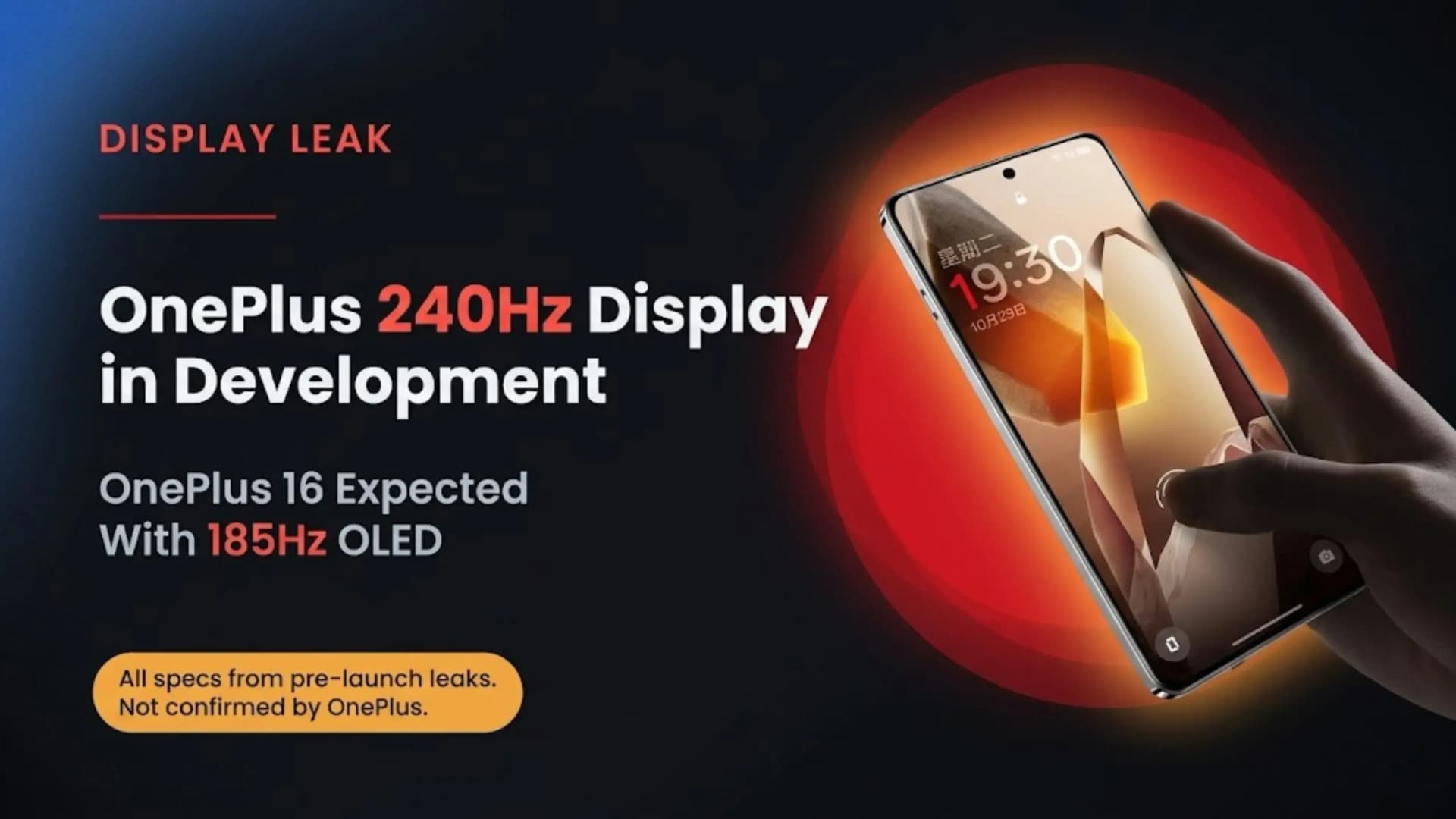
OnePlus Phone display roadmap leak: 165Hz, 185Hz and 240Hz OLED panels detailed.
OnePlus Phone Display 240Hz, OnePlus 16 Expected With 185Hz OLED
OnePlus display roadmap leak: 165Hz already in production (OnePlus Nord 6) | 185Hz expected in OnePlus 16 flagship | 240Hz in long-term development for future flagship | Current preference: 1.5K OLED for efficiency balance | 2K panels considered only if 240Hz+ can be achieved efficiently | Source: Digital Chat Station (Weibo) | OnePlus 16 also expected: Snapdragon 8 Elite Gen 6 + silicon-carbon battery | None confirmed by OnePlus
OnePlus Phone Display Roadmap: 165Hz to 185Hz to 240Hz
Refresh Rates Explained
| Refresh Rate | Where It Appears | What It Means in Practice |
|---|---|---|
| 60Hz | Standard and older smartphones | Visible motion blur during scrolling and animations. Feels noticeably less smooth compared to modern devices. |
| 90Hz | Entry-level and mid-range phones | Noticeably smoother than 60Hz. Good balance between smoothness and battery life. |
| 120Hz | Current flagship and upper mid-range standard | Smooth scrolling, animations, and gaming. Considered the sweet spot for most users in 2026. |
| 144Hz | Premium mid-range and gaming-focused phones | Slightly smoother than 120Hz, especially during fast scrolling and gaming. |
| 165Hz | Gaming phones and devices like the OnePlus Nord 6 | Competitive gaming advantage with ultra-smooth motion and lower perceived input lag. |
| 185Hz | Rumoured devices such as the expected OnePlus 16 | Designed for next-generation high-frame-rate gaming and smoother animations. |
| 240Hz | Future flagship gaming phones (testing stage) | Approaches PC gaming monitor refresh rates. Most beneficial for esports and extremely high-FPS gaming. |
Refresh rate matters more than many other specs because it affects everything you do on your phone, from scrolling and swiping to animations and gaming. The improvement is something you feel, not just measure, which makes it hard to put into numbers but easy to notice. That’s why companies keep raising refresh rates, people like how smooth it feels, even if they can’t always explain it.
OnePlus 16 Specifications: 185Hz OLED and Snapdragon 8 Elite Gen 6

The Engineering Challenge
OnePlus 240Hz Display in Context
Final Verdict
Bottom Line: OnePlus is testing 165Hz (already launched), 185Hz (OnePlus 16, expected) and 240Hz (future development) OLED display panels per leak from Digital Chat Station. OnePlus 16 also expected with Snapdragon 8 Elite Gen 6 and silicon-carbon battery. Current preference is 1.5K OLED for efficiency balance. 240Hz being tested on 2K panels. None confirmed by OnePlus. Source: Digital Chat Station (Weibo).
FAQs
1. Is OnePlus making a phone with a 240Hz display?
According to a leak from Digital Chat Station on Weibo, OnePlus is testing 240Hz panels as part of its long-term display roadmap. This is currently in the testing and development phase, not a confirmed product announcement. The nearer-term target is 185Hz on the upcoming OnePlus 16 flagship.
2. What display will the OnePlus 16 have?
Based on the leak, the OnePlus 16 is expected to feature a 1.5K OLED display with up to 185Hz refresh rate. This would make the OnePlus 16 one of the fastest OLED displays in a mainstream Android flagship. The OnePlus 16 is also expected to use the Snapdragon 8 Elite Gen 6 and a silicon-carbon battery. None of these details are confirmed by OnePlus.
3. What is the difference between 120Hz, 165Hz, 185Hz and 240Hz displays?
Refresh rate is how many times the display updates per second. 120Hz is the current mainstream flagship standard and feels smooth for everyday use. 165Hz improves competitive gaming frame rates and is now in mid-range phones like the OnePlus Nord 6. 185Hz is a further increment primarily noticeable in high-frame-rate gaming. 240Hz is near PC gaming monitor territory and would represent the highest mainstream smartphone display refresh rate outside dedicated gaming phones.
4. Why does OnePlus prefer 1.5K over 2K resolution for its flagships?
OnePlus currently prefers 1.5K OLED panels because they provide a better balance between visual sharpness, display efficiency and battery life than 2K panels at the same or higher refresh rates. A 2K panel at 240Hz requires significantly more GPU workload and battery power than a 1.5K panel at the same refresh rate. OnePlus is evaluating whether 2K at higher refresh rates can be achieved without unacceptable battery drain, which is still under development.
5. What is Snapdragon 8 Elite Gen 6?
The Snapdragon 8 Elite Gen 6 is Qualcomm's next-generation flagship mobile processor expected to succeed the current Snapdragon 8 Elite. It is expected to improve on AI processing, GPU performance and power efficiency. The OnePlus 16 is leaked to use this chip. The Snapdragon 8 Elite Gen 6 has not been officially announced by Qualcomm.
6. Does a higher refresh rate always mean better battery life?
No. Higher refresh rates require the display and GPU to process more frames per second, which increases power consumption. However, LTPO (adaptive refresh rate) technology mitigates this by automatically reducing the refresh rate to 1-10 Hz when content is static, operating at the maximum rate only when needed. The net battery impact of moving from 120 Hz to 240 Hz depends on how well the LTPO management is implemented and how much time is spent in high-motion content.
7. Which phones currently have the highest-refresh-rate displays?
Most flagship Android phones in 2026 use 120Hz or 144Hz displays. Some gaming phones from Asus ROG and Nubia Red Magic offer 165Hz to 240Hz refresh rates in dedicated gaming device form factors. The OnePlus Nord 6, at 165Hz, is one of the first mainstream mid-range phones in the standard smartphone category to exceed 144Hz. OnePlus is targeting 185Hz in the OnePlus 16 and 240Hz in a future flagship.
8. Who leaked the OnePlus 240Hz display roadmap?
The leak comes from Digital Chat Station, a technology tipster active on Weibo with a track record of pre-launch leaks on OnePlus, Vivo, Oppo and other Chinese smartphone brands. The 240Hz display roadmap and OnePlus 16 details have not been officially confirmed by OnePlus.
9. When will a 240Hz OnePlus phone launch? No timeline has been given in the leak. The 240Hz target is described as a longer-term development goal, with 185Hz being the next near-term step expected in the OnePlus 16. A 240Hz OnePlus flagship is likely at least one to two product generations away from the OnePlus 16.
10. Should I wait for the OnePlus 16 instead of buying a current OnePlus phone?
If the 185Hz display and Snapdragon 8 Elite Gen 6 are important to you, waiting for the OnePlus 16 launch is reasonable given it is expected later this year. If you need a phone now, the current OnePlus flagship delivers an excellent 120Hz experience with no meaningful real-world compromises for most use cases. The 185Hz advantage will be most visible to competitive mobile gamers and buyers who have specifically compared different refresh rates side by side.
If you want to sell your old devices, then click here.
Sell with Cashkr
Got an old phone lying around?
Cashkr buys used devices at a fair price with free doorstep pickup and same-day payment across 2,000+ pincodes. Get an upfront quote in seconds.
Sell Old Phone OnlineCheck your phone's value in seconds
Written by