What Affects Your Phone's Resale Value Most, and What Barely Matters
Imagine two people buy the same phone on the same day. Two years later, one gets a quote that's double the other's. That difference isn't just luck.
About seven factors decide your phone’s resale value, but they don’t all matter equally. The first is set before you even open the box. The rest are up to you.
Here’s the list, in order, along with what the evidence really shows for each one.
Advertisement
The Short Answer
Ranked by how much they move the number:
Which phone you bought
How much software support it has left
Physical condition, and whether it has been repaired
There’s also one thing not on the list. Leaving your account signed in doesn’t just lower your phone’s value it wipes it out. I’ll explain more at the end.
First, Why We Will Not Give You Rupee Figures
You will find guides that tell you a cracked back glass costs Rs. 5,000, or a 256GB model is worth Rs. 8,000 more than a 128GB one.
Don’t pay attention to those numbers even we used to include them, but not anymore.
A rupee deduction doesn’t mean much unless you know which phone it’s for. Taking Rs. 3,000 off a Rs. 90,000 flagship barely matters, but the same amount on an Rs. 11,000 budget phone is a big deal. One number can’t fit both.
Published data doesn’t back up those numbers either. We checked real marketplace listings about storage, and the claims didn’t hold up. You’ll find what we discovered in the storage section below.
So, this guide gives you two things: the order of the factors, and real numbers only when they actually exist. If there isn’t a real figure, we’ll tell you.
1. Which Phone You Bought
This is the most important factor, and it’s already set.
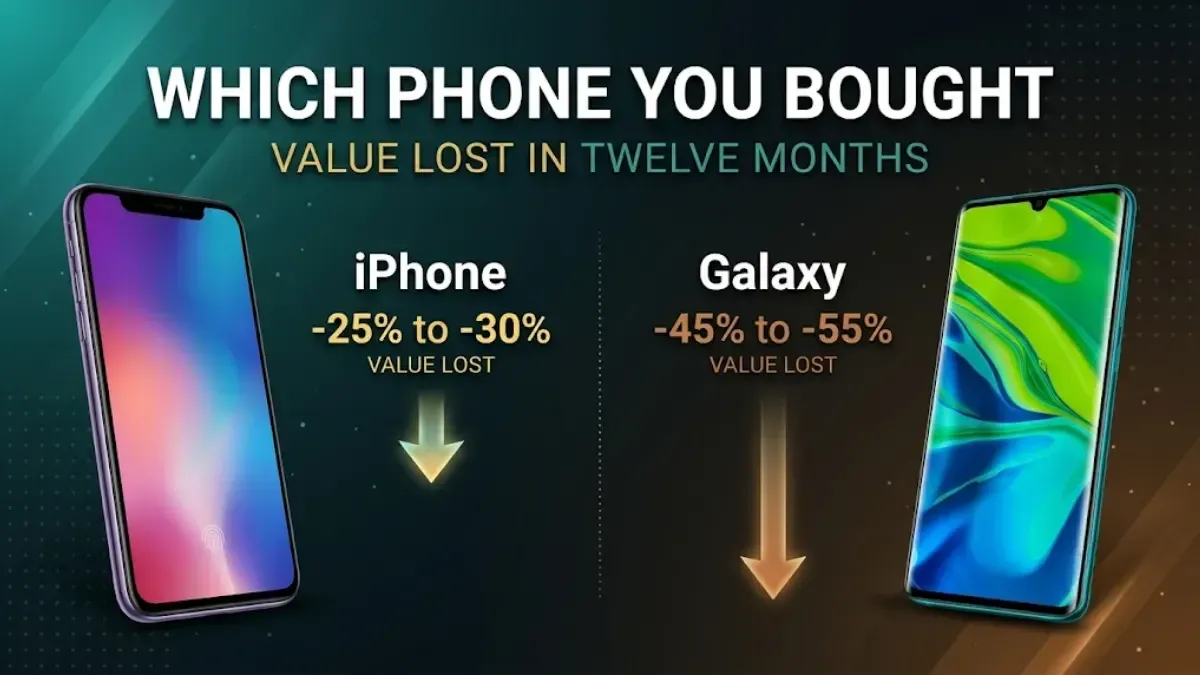
The published depreciation data. SellCell tracks used prices and publishes the value lost per model. Across the first twelve months:
iPhone / Samsung Model
Percentage
iPhone 11
43.8%
iPhone 12
43.8%
iPhone 13
46.2%
iPhone 14
47.7%
iPhone 15
48.2%
Galaxy S23
61.1%
Galaxy S22
66.7%
These numbers are from the United States, so the exact percentages won’t match India. But the ranking and the size of the gap do. An iPhone and a Galaxy S of the same age aren’t in the same league.
Two things in that table most guides miss.
iPhones are depreciating faster than they used to. Read the iPhone column top to bottom: 43.8, 43.8, 46.2, 47.7, 48.2. Each generation holds slightly less than the one before. At five months after launch, the iPhone 16 had lost 35.4 percent, against the iPhone 13's 24.7 percent at the same age. The iPhone advantage is real and it is shrinking.
Samsung is improving at the same time. The Galaxy S25 had lost 46.6 percent at five months, against the Galaxy S22's 51.9 percent. SellCell measured the gap between the iPhone 16 and the Galaxy S25 at 11.2 points, down from much wider. It suggested the lines could cross in the second half of the decade. That is an extrapolation, not a measurement, so treat it as a direction rather than a date.
The Foldable Finding, Which Changes a Common Recommendation
Plenty of guides, including an earlier version of this one, list the "Galaxy S and Z series" together as strong for resale.
The Z series is not. It is one of the weakest categories there is.
Device Category
Percentage 1
Percentage 2
Foldables, all brands
62.3%
71.1%
Standard flagships
49.8%
60.7%
Within Samsung's own range, the Z Fold and Z Flip lost 63.7 percent at six months against the Galaxy S series' 48.3 percent. That is a 15-point gap inside one brand.
So if you care about resale, a foldable costs you more to buy and gives you back less. It shouldn’t be grouped with the Galaxy S series, and we made that mistake before too.
2. How Much Software Support It Has Left
This should be the second most important factor, but most guides put it near the bottom.
It deserves a high spot because it’s the only factor with clear, published numbers. Buyers can check exactly how many years of updates your phone has left, and more people are doing this now.
Phone Model
OS Updates
Security Updates
Pixel 8 and later
7 years
7 years
Galaxy S24, S25
7 years
7 years
Galaxy A16, A26, A36, A56 5G
6 years
6 years
Nothing Phone 3
5 years
7 years
OnePlus 13
4 years
6 years
Xiaomi 15
4 years
6 years
Galaxy S23
4 years
5 years
Older OnePlus Nord models
2 years
3 years
Budget Motorola models
1 year
2 years
Here’s something that surprises many people: Apple promises at leastfive years of security updates from when a phone first goes on sale. Samsung and Google both promise seven years.
So the common belief that iPhones hold value because Apple supports them the longest isn’t backed up by these promises. On paper, Apple actually offers less than its two main competitors.
What really keeps iPhone prices high is demand, not the length of support. There are lots of buyers for used iPhones, and they know what they want and are willing to pay for it. This is important to know, because a Galaxy phone with seven years of support can still sell for less than an iPhone.
Here’s how to use this information: a phone with five years of updates left is worth more than the same phone with just one year left. Check your model’s support window to see where you stand.
3. Physical Condition and Repair History
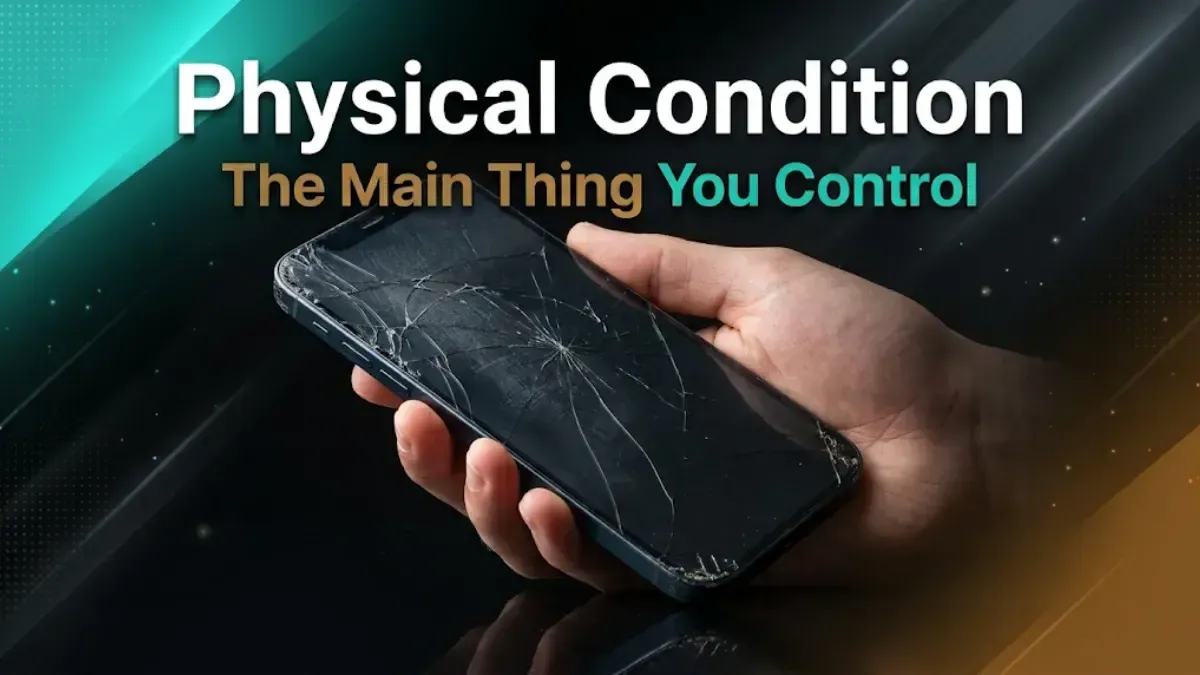
Condition is the main thing you can control yourself.
What costs you, roughly in order: a cracked screen, cracked back glass, camera lens damage, deep dents, water damage, and screen burn-in on an OLED panel. Light scuffs on the frame cost the least and often nothing.
We won’t give a rupee value for each issue, for the reasons explained earlier.
But there’s something even more important that most guides don’t mention at all.
A cheap repair can leave your phone worth less than the damage did. When a screen or battery is replaced with a non-genuine part, the phone knows. On an iPhone, it shows an "Unknown Part" or service message in Settings that cannot be cleared. More Android makers are doing the same.
A buyer looking at a crack knows exactly what is wrong and what it costs to fix. A buyer looking at a parts warning does not know what was replaced, by whom, or what else was opened up along the way. Uncertainty prices worse than visible damage.
So the rule is simple: get an authorised repair or don’t repair at all. Trying to save money with a market repair often ends up costing you more in lost value.
The cheapest way to protect your phone’s condition is to use a case and screen protector from day one. Before any inspection, take them off so the real condition is clear.
4. Battery Health
Battery health is the first thing inspectors check, but most owners never look at it.
On an iPhone, you’ll find it under Settings > Battery > Battery Health and Charging. On Android, it depends on the brand, and many phones don’t show it directly.
Here’s what the numbers mean: Apple says the iPhone 15 and newer should keep 80 percent of their original battery capacity after 1,000 full charge cycles. The iPhone 14 and older are rated for 500 cycles. This is a real improvement, not just marketing, and it’s why newer iPhones often have better battery life than older ones of the same age.
When your battery drops below 80 percent, iOS shows a service message. At that point, a battery replacement is factored into any quote you get.
Check your battery health before asking for a quote. It won’t change the offer, but it helps avoid surprises later.
One Thing to Stop Worrying About
Charging your phone overnight doesn’t harm modern batteries. That advice is outdated, but it still shows up everywhere even in older versions of this guide.
Modern phones stop charging once they reach 100 percent. Both iOS and Android often keep the battery near 80 percent overnight and finish charging just before you wake up.
Heat is what really wears out a battery. Playing games while fast charging, leaving your phone on a car dashboard, or charging it under a pillow all make things worse. In Indian summers, this is even more important.
5. Timing
Used prices fall every month, and they step down when the successor launches.
So the advice is simple: sell before the new model launches, not after. We won’t give you an exact number like Rs. 8,000, because it depends on your specific phone.
What we can tell you is how the price drops. SellCell’s numbers show that the iPhone 16 lost 41.2 percent of its value within two weeks of launch, compared to 33.0 percent for the iPhone 14 at the same point. The biggest drop happens right after launch, and it’s getting steeper with each new generation.
Here’s the practical advice: if you plan to upgrade, sell your phone the month before the new model is announced. If you’ve already missed that window, the next best time is now; waiting never helps. Our guide on when to sell your phone has more details.
6. The Box, the Charger and the Invoice
First, they add a bit to the price, since a complete set is worth more than just the phone. set is worth more than a bare handset.
They speed up the check and build trust, because an invoice proves the phone is legitimately yours. That second effect matters more in a private sale than in a buyback.
If you’ve lost these items, it’s not a big problem, and it’s not worth buying replacements just to make it look complete.
7. Storage Size, Which Matters Less Than You Have Been Told
Storage comes last on the list, and that’s because we checked the data.
Pulling live marketplace listings, some 256GB iPhones were listed below some 128GB ones of the same model. On the iPhone 13, the real gap between the two tiers came out at roughly Rs. 1,000 to Rs. 2,000.
You might see numbers like Rs. 5,000 to Rs. 8,000 quoted elsewhere even in older versions of this page but we didn’t find that gap in real listings.
Here’s why: storage matters a lot for new phones, but after three years, the condition of the phone matters much more. Battery health, screen condition, repair history, and how eager the seller is all affect the price more than storage does.
So don’t pay extra for more storage thinking you’ll get it back later. Buy the storage you actually need.
The One That Takes the Value to Almost Nothing
This isn’t just another factor; it’s a dealbreaker.
If you factory reset while still signed in to your Google or Apple account, the phone locks itself to you. Factory Reset Protection on Android, Activation Lock on iPhone. The next owner cannot set it up at all.
A locked phone, even in perfect condition, is worth much less than an unlocked phone with a cracked screen. That’s because only the parts have value. We won’t give a number for this the point is, it cancels out everything else in this guide.
This is also the most common reason doorstep pickups can’t be completed, and it usually happens with phones that are otherwise in great condition.
What to Actually Do, in Order
While you own the phone
Case and screen protector from day one.
Authorized repairs only, or none.
Keep it out of heat, and stop worrying about overnight charging.
Keep the box, charger, cable, and invoice somewhere you will find them.
When you decide to sell
Check your battery health and note the number.
Look up your model's remaining software support.
Back up your data, and open the backup to check it worked.
Move your authenticator app to the new phone.
Sign out of your Google or Apple account. This is the step that matters.
Take out the SIM and memory card, and remove any eSIM.
Factory reset. Modern phones encrypt their storage, so the reset destroys the encryption key and what is left cannot be read. You do not need to buy wiping software.
Take off the case and protector, clean the phone, and describe every fault honestly.
That last step is what decides if your quote stays the same. Most disappointing pickups happen because there’s a difference between what the seller says and what the inspector finds.
1. What is the biggest factor that affects phone resale value?
Which phone you bought. Published United States tracking shows iPhones losing roughly 44 to 48 percent of their value in the first twelve months. Recent Galaxy S models lost 61 to 67 percent. That gap is larger than anything else on the list, and it is already fixed by the time you own the phone. Everything else decides how close to that ceiling you get.
2. Do Samsung foldables hold their value well?
No, and this is where a lot of advice is wrong. Tracked data puts foldables at 62.3 percent of value lost by six months against 49.8 percent for standard flagships. Inside Samsung's own range, the Z Fold and Z Flip lost 63.7 percent at six months against 48.3 percent for the Galaxy S series.
3. Do iPhones hold value because Apple supports them longest?
No. Apple has formally committed to a minimum of five years of security updates, while Samsung and Google both promise seven on their recent flagships. iPhones hold value because used iPhone demand is deep and consistent, which is a different mechanism from a longer support window.
4. How much does battery health affect phone resale value?
Enough that it is the first thing checked. Apple rates the iPhone 15 and later at 1,000 charge cycles to 80 percent capacity, and the iPhone 14 and earlier at 500. Below 80 percent, iOS shows a service message and a battery replacement gets priced into any quote. Check your number before asking for a quote so it does not change later.
5. Should I repair a cracked screen before selling?
Usually no. An authorised repair rarely costs less than it adds, and a cheaper third-party repair triggers an "Unknown Part" message in Settings that cannot be cleared. A buyer can see something was replaced but not what else was done inside, and that uncertainty prices worse than visible damage.
6. Is a 256GB phone worth much more than a 128GB one second-hand?
Less than you have been told. In live listings we checked, some 256GB iPhones sat below 128GB units of the same model, and the real gap on the iPhone 13 came out around Rs. 1,000 to Rs. 2,000. On an older phone the condition of that specific unit matters far more than the storage tier.
7. Does overnight charging hurt my phone's resale value?
No. Modern phones stop drawing current at 100 percent, and both iOS and Android hold the charge near 80 percent overnight. Heat is what wears a battery out, so avoid gaming while fast charging and leaving the phone somewhere hot.
8. When is the best time to sell a phone?
Before the successor is announced rather than after, because the steepest part of the price curve is right at launch. Tracked figures show the iPhone 16 losing 41.2 percent within two weeks of its launch. If you have already missed that window, now beats later, because waiting has never helped.
9. Does the original box increase phone resale value?
A little, and it speeds up the sale, because the invoice proves the phone is legitimately yours. It is not worth buying replacements if you have lost them.
10. What should I do before selling my phone?
Back up and check the backup, move your authenticator app, sign out of your Google or Apple account, remove the SIM and eSIM, then factory reset, in that order. Signing out before the reset is critical, because resetting while signed in locks the phone to your account and nobody else can set it up.
11. Why will you not tell me the exact rupee deduction for a cracked screen?
Because a single figure cannot describe two different phones. A Rs. 3,000 deduction is nothing on a Rs. 90,000 flagship and a quarter of the sale on a Rs. 11,000 budget phone. Any guide quoting one number for all phones has made it up. Get a quote for your specific phone instead.
Stay in the loop
Weekly tech insights in your inbox. No spam, ever.


 Yaskar Jung ShahPublished at: Jul 14, 2026·18 min read