Samsung Galaxy S26 Ultra vs Google Pixel 10 Pro XL: Price in India, Specifications, and Full Comparison
Quick Summary: The Samsung Galaxy S26 Ultra starts at Rs. 1,30,999 and stands out for its performance, zoom cameras, build quality, and gaming. The Google Pixel 10 Pro XL starts at Rs. 1,24,999 and is better for display brightness, battery size, RAM, clean Android software, and AI-powered photography. Both phones get 7 years of OS updates. The best choice depends on how you use your phone.
The Samsung Galaxy S26 Ultra and Google Pixel 10 Pro XL are two of the best Android flagships available in India right now. Both are top-tier phones in 2026, come with high price tags, and offer a premium experience. However, each is designed with a different approach in mind.
Samsung made the Galaxy S26 Ultra for productivity and performance, featuring a quad-camera zoom system, a built-in S Pen, and the fastest Snapdragon chip. Google focused the Pixel 10 Pro XL on computational photography, offering clean Android, Gemini-powered AI, a bright display, a big battery, and lots of RAM.
This comparison looks at price, display, processor, cameras, battery, software, storage, and connectivity to help you decide which flagship suits your needs in India.
Samsung Galaxy S26 Ultra vs Google Pixel 10 Pro XL: Price in India
The Google Pixel 10 Pro XL is the more affordable entry point of the two, starting at Rs. 1,24,999 for the 256GB base variant. Notably, this is currently the lowest price the Pixel 10 Pro XL has been available at since its launch, making this a solid time to pick it up if you are considering it.
The Samsung Galaxy S26 Ultra starts at Rs. 1,30,999 for the 256GB model, down from its original launch price of Rs. 1,39,999. Samsung also offers higher storage configurations in 512GB and 1TB variants, giving buyers more flexibility if they need extra space for large media libraries or heavy app usage. The Pixel 10 Pro XL currently only ships in a 256GB configuration in India.
If you want to save money, the Pixel 10 Pro XL is Rs. 6,000 cheaper and still feels premium. If you need more storage or plan to use other Samsung devices, the Galaxy S26 Ultra is worth the extra cost for its extra options.
Samsung Galaxy S26 Ultra vs Google Pixel 10 Pro XL: Display
Google Pixel 10 Pro XL Display
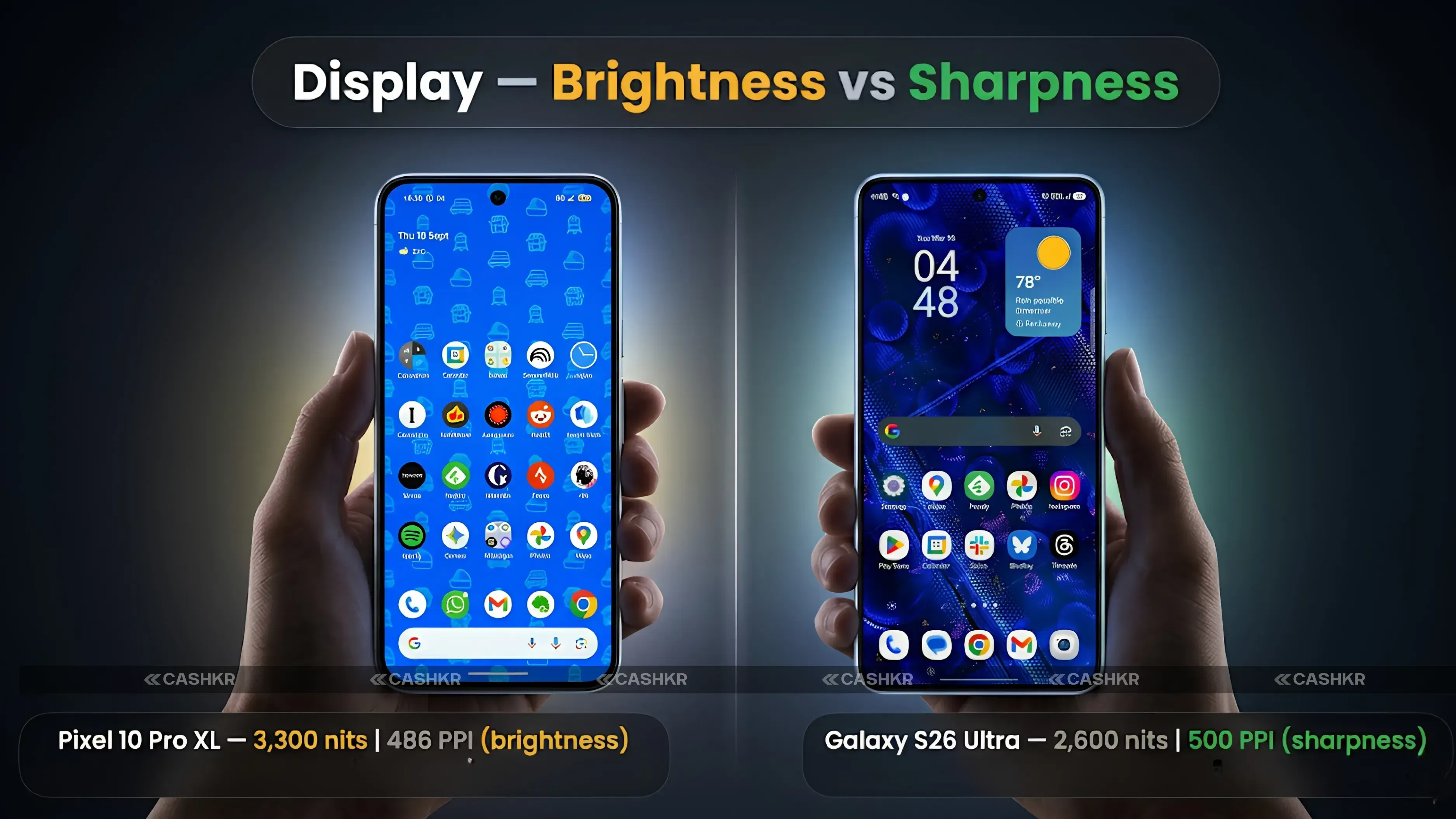
The Pixel 10 Pro XL carries a 6.8-inch OLED panel with QHD+ resolution, a 120Hz refresh rate, and HDR10+ certification. The standout number here is its 3,300 nits peak brightness, which is exceptional for outdoor readability in direct sunlight. Pixel density is 486 ppi, delivering sharp, detailed visuals across text and media alike.
Samsung Galaxy S26 Ultra Display
Samsung equips the Galaxy S26 Ultra with a slightly larger 6.9-inch AMOLED panel, also at QHD+ resolution with a 120Hz adaptive refresh rate and HDR10+ support. Adaptive refresh rate means the display scales down intelligently to conserve battery when displaying static content. Peak brightness reaches 2,600 nits, and pixel density is 500 ppi, making it fractionally sharper than the Pixel screen.
Display Winner: Google Pixel 10 Pro XL. Its 3,300 nits peak brightness makes it much easier to see outdoors. The Galaxy S26 Ultra has slightly higher pixel density, but brightness is more important for daily use in India's sunlight.
Samsung Galaxy S26 Ultra vs Google Pixel 10 Pro XL: Design and Build Quality
Google Pixel 10 Pro XL Build
Google has gone with an aluminum frame and Gorilla Glass Victus 2 protection on the Pixel 10 Pro XL. The phone carries an IP68 rating for dust and water resistance and includes stereo speakers. It weighs 232 grams, which puts it on the heavier side for a flagship but is not unusual for a large-battery 6.8-inch device.
Samsung Galaxy S26 Ultra Build
Samsung uses its Armor Aluminum frame alongside Gorilla Glass Armor 2.0 on the Galaxy S26 Ultra, a step up in protection over standard Gorilla Glass. The phone also carries IP68 certification and stereo speakers. Despite having a larger 6.9-inch display, the Galaxy S26 Ultra weighs only 214 grams, making it noticeably lighter than the Pixel in hand.
Build Quality Winner: Samsung Galaxy S26 Ultra. It has stronger glass, a lighter body even with a bigger screen, and an Armor Aluminium frame, making it the better-built phone.
Samsung Galaxy S26 Ultra vs Google Pixel 10 Pro XL: Processor and Performance
Google Pixel 10 Pro XL Performance
The Pixel 10 Pro XL is powered by Google's in-house Tensor G5 chipset paired with a PowerVR DXT-48-1536 GPU and 16GB of LPDDR5X RAM. The Tensor G5 is built with AI and machine learning workloads as its primary focus rather than raw compute speed. This design philosophy makes it excellent at on-device AI tasks like voice recognition, live translation, and computational photography, but it does not match the Snapdragon 8 Elite Gen 5 in gaming benchmarks or sustained performance under load.
Samsung Galaxy S26 Ultra Performance
Samsung uses the Qualcomm Snapdragon 8 Elite Gen 5 in the Galaxy S26 Ultra, paired with the Adreno 840 GPU and 12GB of LPDDR5X RAM. The Snapdragon 8 Elite Gen 5 is one of the fastest mobile chipsets available in 2026, delivering class-leading CPU and GPU performance, improved thermal efficiency compared to previous generations, and sustained performance even during extended gaming sessions. The Adreno 840 GPU specifically makes a significant difference for mobile gamers running demanding titles at high frame rates.
Performance Winner: Samsung Galaxy S26 Ultra. The Snapdragon 8 Elite Gen 5 is faster for computing, gaming, and heavy use. The Pixel has more RAM, which helps with multitasking, but overall, Samsung is ahead on performance.
Samsung Galaxy S26 Ultra vs Google Pixel 10 Pro XL: Cameras
Google Pixel 10 Pro XL Camera System
Google equips the Pixel 10 Pro XL with a triple rear camera setup consisting of a 50MP primary sensor, a 48MP telephoto lens, and a 48MP ultra-wide camera. The front camera is a 42MP selfie shooter, the highest resolution of the two. Google's camera strength lies in its computational photography processing: Pixel Shift, Ultra HDR, Action Mode, Best Take, Pro Mode, and Macro Mode all add layers of versatility. The Tensor G5 chip processes images on-device with Google's AI pipeline, producing natural color rendition and impressive results in challenging lighting.
Samsung Galaxy S26 Ultra Camera System
Samsung gives the Galaxy S26 Ultra a quad-camera rear system: a 200MP primary sensor, a 50MP periscope telephoto, a 50MP ultra-wide, and a 10MP telephoto for additional zoom range. The 12MP front camera handles selfies and video calls. Galaxy AI powers enhancements such as Best Face, Audio Eraser, AI document scanning, and HDR10+ processing. The real differentiator for Samsung is zoom versatility: having both a periscope telephoto and a secondary telephoto lens gives the S26 Ultra a much wider range of zoom options than the Pixel, and the 200MP main sensor captures exceptional detail in bright conditions.
Camera Winner: Samsung Galaxy S26 Ultra is best for zoom and versatility, while the Google Pixel 10 Pro XL is better for computational photography. Samsung has better hardware and zoom, but the Pixel excels at natural colors, AI photo editing, and smart camera features. Pick based on how you like to take photos.
Samsung Galaxy S26 Ultra vs Google Pixel 10 Pro XL: Battery
Google Pixel 10 Pro XL Battery
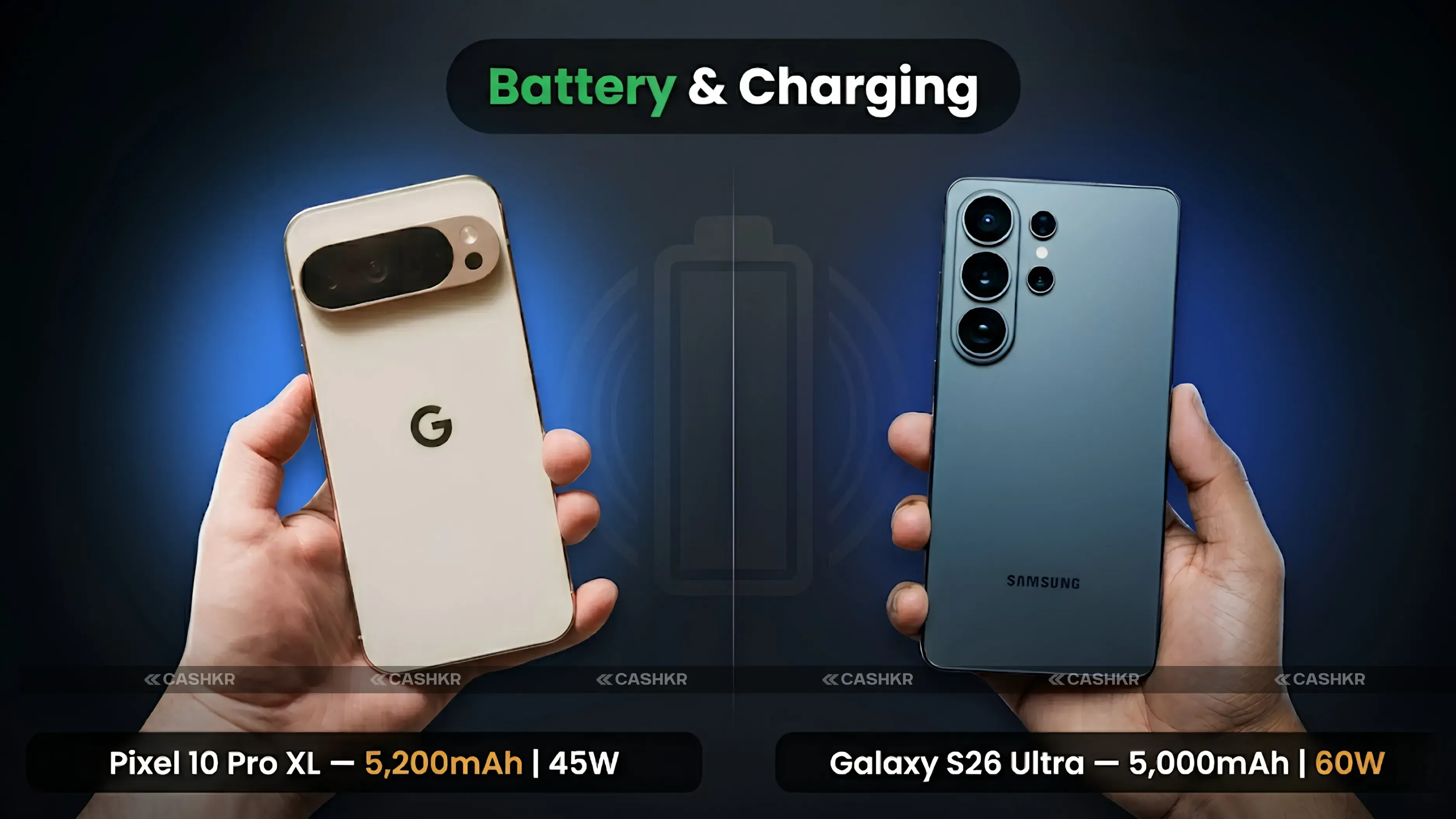
The Pixel 10 Pro XL carries a 5,200mAh battery with 45W wired fast charging and wireless charging support. Google's software optimization with the Tensor G5 chip is well-tuned for battery efficiency, and the combination of a large cell and smart power management gives the Pixel strong real-world endurance for a phone of its size.
Samsung Galaxy S26 Ultra Battery
The Galaxy S26 Ultra features a 5,000mAh battery with 60W wired fast charging and wireless charging. Samsung edges ahead in charging speed, meaning less time spent plugged in when you need a quick top-up. The 200 mAh difference in capacity is small enough that real-world usage will depend more on software optimization than on raw capacity.
Battery Winner: Google Pixel 10 Pro XL. Its bigger 5,200mAh battery and efficient software give it a slight edge in battery life. Samsung charges faster at 60W, but the Pixel lasts longer on a full charge.
Samsung Galaxy S26 Ultra vs Google Pixel 10 Pro XL: Software and AI Features
Google Pixel 10 Pro XL Software
The Pixel 10 Pro XL runs a clean, near-stock version of Android. There is no third-party skin, minimal bloatware, and updates arrive on Pixel devices before any other Android phone. AI features are powered by Gemini Live and include Circle to Search, Live Translate, Pixel Screenshots, and Call Assist. Google promises 7 years of OS and security updates, matching Samsung's commitment. For users who want Android as Google intended, the Pixel delivers it with no compromises.
Samsung Galaxy S26 Ultra Software
Samsung runs One UI on the Galaxy S26 Ultra, a fully customized Android skin with a wide range of features layered on top of the base OS. Galaxy AI powers intelligent enhancements, including AI Image Enhancements, Audio Eraser, AI Suggestions, and AI Document Scanning. The S Pen integration is deeply built into One UI, enabling handwriting recognition, note-taking, screen-off memos, and precision input that has no equivalent on the Pixel. Samsung also commits to 7 years of OS updates, bringing both phones to the same support horizon.
Software Winner: It depends on what you like. The Pixel is best for clean Android, quick updates, and strong Gemini AI features. Samsung is better for more features, customisation, productivity tools, and S Pen support. Choose based on how you use your phone.
Samsung Galaxy S26 Ultra vs Google Pixel 10 Pro XL: RAM and Storage
On RAM, the Pixel 10 Pro XL takes a clear lead with 16GB of LPDDR5X memory, compared to the Galaxy S26 Ultra's 12GB. More RAM translates to smoother multitasking and fewer app refreshes, which benefits power users who juggle many apps simultaneously.
On storage, Samsung has the advantage. The Galaxy S26 Ultra is available in 256GB, 512GB, and 1TB configurations, all using UFS 4.0 flash storage. The Pixel 10 Pro XL currently ships only in 256GB in India, and it also uses UFS 4.0. For users who store large amounts of media, shoot high-resolution video, or prefer not to rely on cloud storage, Samsung offers significantly more storage.
Samsung Galaxy S26 Ultra vs Google Pixel 10 Pro XL: Connectivity
Both phones are equal when it comes to connectivity. They support 5G, Wi-Fi 7, Bluetooth 6, NFC, USB Type-C, and are IP68 water- and dust-resistant. Both also have stereo speakers. There’s no real difference here.
Where Samsung pulls ahead is in ecosystem depth. One UI integrates tightly with Samsung's broader product range, including Galaxy tablets, laptops, smartwatches, and earbuds. The S Pen on the Galaxy S26 Ultra also connects wirelessly for remote operations. Pixel benefits from deep Google service integration, but Samsung's hardware ecosystem is broader for users already invested in it.
Samsung Galaxy S26 Ultra vs Google Pixel 10 Pro XL: Full Specifications Comparison
Specification
Samsung Galaxy S26 Ultra
Google Pixel 10 Pro XL
Price in India (256GB)
₹1,30,999 (launch price: ₹1,39,999)
₹1,24,999
Display Size
6.9-inch AMOLED
6.8-inch OLED
Resolution
QHD+
QHD+
Refresh Rate
120Hz adaptive
120Hz
Peak Brightness
2,600 nits
3,300 nits
Pixel Density
500ppi
486ppi
HDR Support
HDR10+
HDR10+
Processor
Snapdragon 8 Elite Gen 5
Google Tensor G5
GPU
Adreno 840
PowerVR DXT-48-1536
RAM
12GB LPDDR5X
16GB LPDDR5X
Storage Options
256GB / 512GB / 1TB (UFS 4.0)
256GB (UFS 4.0)
Rear Camera (Main)
200MP
50MP
Rear Camera (Telephoto)
50MP periscope + 10MP telephoto
48MP telephoto
Rear Camera (Ultra-wide)
50MP
48MP
Front Camera
12MP
42MP
Battery
5,000mAh
5,200mAh
Wired Charging
60W fast charging
45W fast charging
Wireless Charging
Yes
Yes
Which One Should You Buy?
Buy the Google Pixel 10 Pro XL if:
You want the cleanest Android experience available without any bloatware or customization layers on top. The Pixel 10 Pro XL is also the right pick if you rely heavily on Google's AI tools, prefer natural-looking computational photography over megapixel counts, want more RAM for multitasking, need the brightest display possible for outdoor use, or are working within a tighter flagship budget at Rs. 1,24,999.
Buy the Samsung Galaxy S26 Ultra if:
You are a mobile gamer who needs the fastest chipset and GPU available. The Galaxy S26 Ultra is also the better choice if you shoot a lot of zoom photography, need the S Pen for handwriting and productivity, want higher storage configurations up to 1TB, prefer Samsung's ecosystem of connected devices, or prioritize build quality and a lighter body in a large phone.
Final Verdict
The Samsung Galaxy S26 Ultra and Google Pixel 10 Pro XL are both exceptional flagships in 2026, and neither is a bad choice. The decision comes down to what kind of smartphone user you are and which compromises you are willing to make at the premium end of the market.
Samsung wins the head-to-head categories of raw performance, camera hardware versatility, build quality, weight, storage options, and charging speed. It is the most complete device on paper for power users, gamers, and content creators who want the maximum in every department. The S Pen remains a unique tool with no direct competitor on Android.
Google wins on display brightness, battery size, RAM, software cleanliness, and AI integration depth. The Pixel 10 Pro XL is also the cheaper entry point by Rs. 6,000 at the base price, which is not insignificant in the premium segment. Its computational photography pipeline consistently produces excellent results without requiring users to think about settings or modes.
If you want the most versatile flagship Android phone in 2026, the Samsung Galaxy S26 Ultra is the better choice. If you prefer a smarter, cleaner, and more AI-focused phone with great battery life and the brightest screen, go for the Google Pixel 10 Pro XL.
Bottom Line: The Samsung Galaxy S26 Ultra is best for gamers, zoom photographers, S Pen fans, and those who need lots of storage. The Google Pixel 10 Pro XL is better for people who want clean software, multitask a lot, use AI features, or need the brightest screen. Both are great at this price, so choose based on what matters most to you.
FAQs
1. What is the price difference between the Samsung Galaxy S26 Ultra and Google Pixel 10 Pro XL in India?
The Google Pixel 10 Pro XL starts at Rs. 1,24,999 for the 256GB variant, which is currently its lowest price since launch. The Samsung Galaxy S26 Ultra starts at Rs. 1,30,999 for the 256GB variant, reduced from its original launch price of Rs. 1,39,999. This means the Pixel 10 Pro XL is currently Rs. 6,000 cheaper at the base level, though Samsung offers additional 512GB and 1TB storage options that take the price higher for buyers who need more internal storage.
2. Which phone has a better display: Samsung Galaxy S26 Ultra or Google Pixel 10 Pro XL?
The Google Pixel 10 Pro XL has a higher peak brightness at 3,300 nits compared to the Samsung Galaxy S26 Ultra's 2,600 nits, giving it better outdoor visibility in direct sunlight. The Galaxy S26 Ultra has a slightly larger 6.9-inch AMOLED panel than the Pixel's 6.8-inch OLED, and edges out the Pixel on pixel density at 500ppi versus 486ppi. Both panels support QHD+ resolution, 120Hz refresh rate, and HDR10+. For outdoor users in sunny conditions, the Pixel wins on brightness. For slightly sharper visuals, Samsung wins.
3. Which processor is faster: Snapdragon 8 Elite Gen 5 or Google Tensor G5?
The Qualcomm Snapdragon 8 Elite Gen 5 in the Samsung Galaxy S26 Ultra is faster in raw compute performance, gaming benchmarks, and GPU-intensive tasks. The Adreno 840 GPU outperforms the PowerVR DXT-48-1536 in the Pixel 10 Pro XL for gaming specifically. The Tensor G5 is not designed for raw speed; it is optimized for AI and machine learning tasks, which makes it excellent for on-device AI features, voice processing, and computational photography. For gaming and sustained workloads, Samsung wins. For AI-driven tasks, the Pixel holds its own.
4. Which phone has a better camera system?
The Samsung Galaxy S26 Ultra has superior camera hardware with a 200MP primary sensor, a 50MP periscope telephoto, a 10MP telephoto, and a 50MP ultra-wide, giving it four lenses and an exceptional zoom range. The Google Pixel 10 Pro XL has a 50MP primary, 48MP telephoto, and 48MP ultra-wide with a 42MP front camera that beats Samsung's 12MP selfie shooter. In terms of zoom versatility and raw resolution, Samsung wins clearly. In terms of computational photography quality, natural color processing, and AI-assisted editing, the Pixel produces results that often rival or beat those of higher-resolution competitors. The best camera depends on your shooting priorities.
5. Which phone has a longer battery life: Galaxy S26 Ultra or Pixel 10 Pro XL?
The Google Pixel 10 Pro XL has a slightly larger 5,200mAh battery compared to the Samsung Galaxy S26 Ultra's 5,000mAh cell. Google's software optimization with the Tensor G5 is also well-tuned for power efficiency, which tends to translate into strong real-world endurance. Samsung compensates with faster 60W wired charging versus the Pixel's 45W, meaning the Galaxy S26 Ultra refills more quickly when it does need a charge. Both support wireless charging. For overall battery endurance, the Pixel holds the edge. For charging speed, Samsung wins.
6. Does the Samsung Galaxy S26 Ultra have an S Pen?
Yes, the Samsung Galaxy S26 Ultra includes a built-in S Pen, which is stored inside the phone's body and supports handwriting recognition, note-taking, screen-off memos, precision drawing, and remote shutter functionality. The S Pen is one of the Galaxy S26 Ultra's most distinctive features and has no equivalent on the Google Pixel 10 Pro XL. For users who frequently take handwritten notes, annotate documents, or want a stylus for precision tasks, this is a unique advantage that only the Samsung device offers in this comparison.
7. Which phone is better for gaming?
The Samsung Galaxy S26 Ultra is clearly the better gaming phone between the two. The Qualcomm Snapdragon 8 Elite Gen 5 paired with the Adreno 840 GPU delivers class-leading gaming performance, handles demanding titles at high frame rates, and maintains sustained performance better under thermal load. The improved thermal efficiency of the Snapdragon 8 Elite Gen 5 also means less throttling during long gaming sessions. The Google Tensor G5 in the Pixel 10 Pro XL performs well in games, but it is not designed to compete with Snapdragon in GPU-intensive workloads.
8. Which phone has more RAM and storage?
The Google Pixel 10 Pro XL has 16GB of LPDDR5X RAM, compared to the Samsung Galaxy S26 Ultra's 12GB of LPDDR5X RAM. More RAM is advantageous for multitasking and keeping more apps alive in the background. On storage, Samsung has the advantage: the Galaxy S26 Ultra is available in 256GB, 512GB, and 1TB UFS 4.0 configurations. The Pixel 10 Pro XL is currently available in India only in a 256GB UFS 4.0 variant. If storage capacity is a priority, Samsung gives you more room to expand.
9. How long will each phone receive software updates?
Both the Samsung Galaxy S26 Ultra and the Google Pixel 10 Pro XL are committed to 7 years of OS updates and security patches. This is among the longest software support commitments available on any Android smartphone in 2026 and puts both devices on par with each other on this front. Google historically delivers Android updates to Pixel devices first before any other manufacturer, which means the Pixel 10 Pro XL will likely see new Android versions sooner each year. Samsung's One UI updates follow shortly after Google's rollout.
10. Overall, which is a better buy in India: Samsung Galaxy S26 Ultra or Google Pixel 10 Pro XL?
The Samsung Galaxy S26 Ultra is the better buy for users who prioritize gaming performance, versatile zoom camera, S Pen productivity, build quality, and higher storage options. The Google Pixel 10 Pro XL is the better buy for users who prefer clean Android software, AI-powered features, a brighter display, more RAM, better battery endurance, and a lower entry price. If forced to pick one for the widest range of use cases, the Galaxy S26 Ultra has a slight edge in overall hardware. But if software experience and value at the base price matter most, the Pixel 10 Pro XL is the smarter choice.
If you want to sell your old devices, then click here.
 Yaskar Jung ShahUpdated: Aug 8, 2026·23 min read