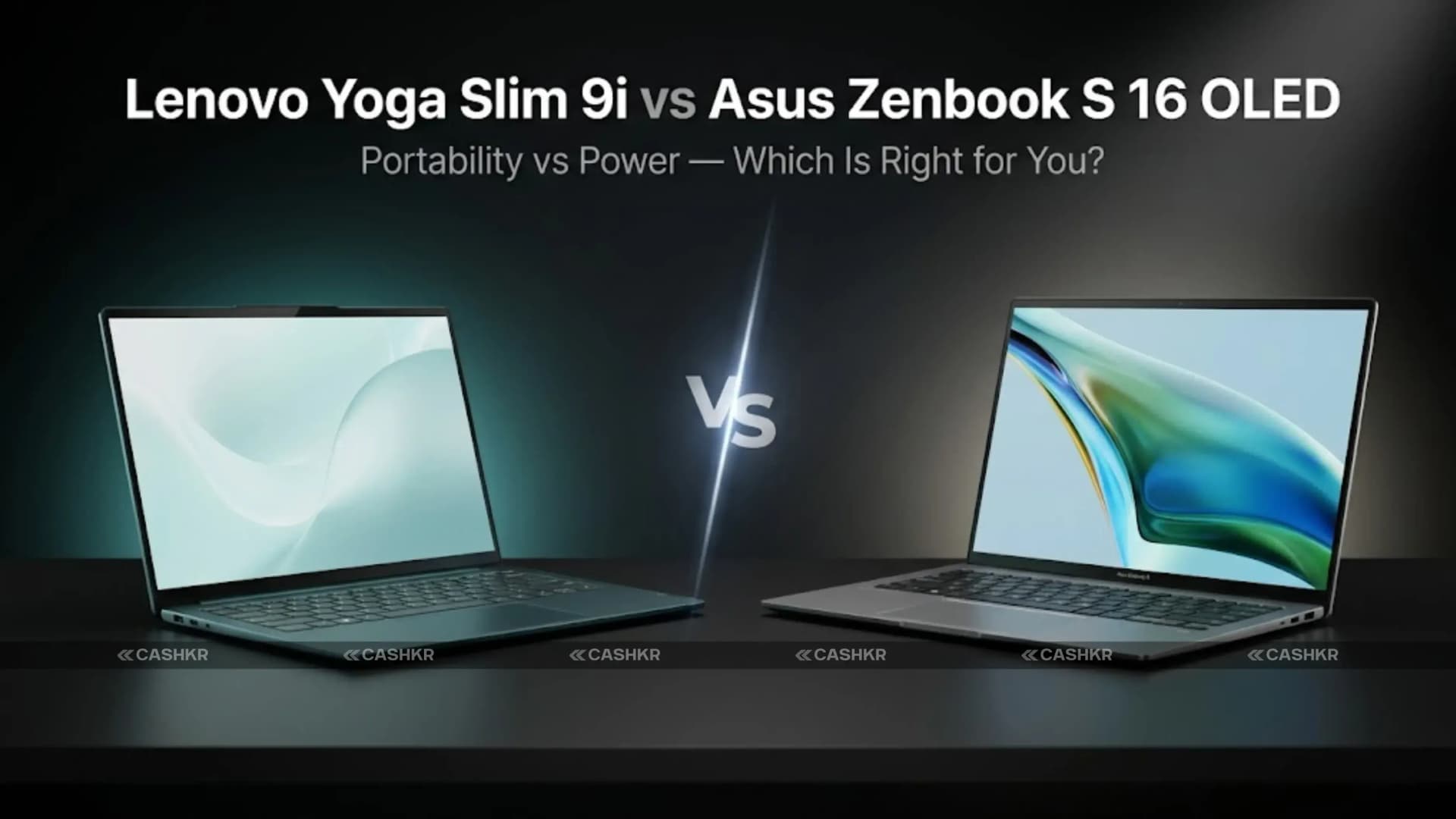
Lenovo Yoga Slim 9i vs Asus Zenbook S 16 OLED: The Right Premium Laptop for Your Needs
Both of these laptops are top-tier ultrabooks, but each one is built with different priorities in mind.
The Lenovo Yoga Slim 9i is made for portability. It weighs just 1.25 kg and has a 4K touchscreen in a 14-inch frame, a 32MP webcam, an Intel Core Ultra 7 with Intel Arc graphics, and a stylish Tidal Teal finish. If you travel a lot and want a lightweight, attractive laptop, this is a great choice.
The Asus Zenbook S 16 OLED takes a different approach. It’s heavier at 1.50 kg and has a larger 16-inch screen. In exchange, you get a beautiful OLED display, a more powerful AMD Ryzen 9 HX 370 processor, a wider range of ports like USB-A, HDMI, and a microSD slot, plus 1TB of SSD storage.
This comparison highlights where each laptop stands out, helping you choose the one that fits your needs best.
Quick answer: Choose the Lenovo Yoga Slim 9i for portability, 4K resolution, webcam quality, and a lightweight build. Go with the Asus Zenbook S 16 OLED for stronger processing power, a larger OLED display, more ports, and better performance with heavy tasks.
Lenovo Yoga Slim 9i vs Asus Zenbook S 16 OLED: Full Specs
Features
Lenovo Yoga Slim 9i
Asus Zenbook S 16 OLED
Display Size
14 inches
16 inches
Resolution
3840 x 2400 (4K)
2880 x 1800 OLED
Panel Type
IPS or similar
OLED
Refresh Rate
120Hz
120Hz
Touchscreen
Yes
Yes
Processor
Design and Portability: Lenovo Is Lighter, Asus Is Larger
The weight difference matters if you carry your laptop every day.
The Lenovo Yoga Slim 9i weighs just 1.25 kg, making it one of the lightest 14-inch premium ultrabooks. It’s easy to carry through airports, between meetings, or on your daily commute. The Tidal Teal finish also gives it a unique look compared to the usual silver or grey laptops.
The Asus Zenbook S 16 OLED weighs 1.50 kg, which is still light for a 16-inch laptop. Its aluminium body feels sturdy and durable. However, you’ll notice the extra weight compared to the Lenovo, especially after a full day of travel.
If you mostly work at a desk, the weight difference won’t matter much. But if you’re always on the move, the Lenovo’s lighter build makes a real difference every day.
Winner: Lenovo Yoga Slim 9i for portability and light weight (1.25 kg). Asus Zenbook S 16 OLED for a larger size that’s better for desk work.
Display: Two Very Different but Both Excellent Screens
This is an interesting category since both laptops have excellent displays, but each is optimized for different uses.
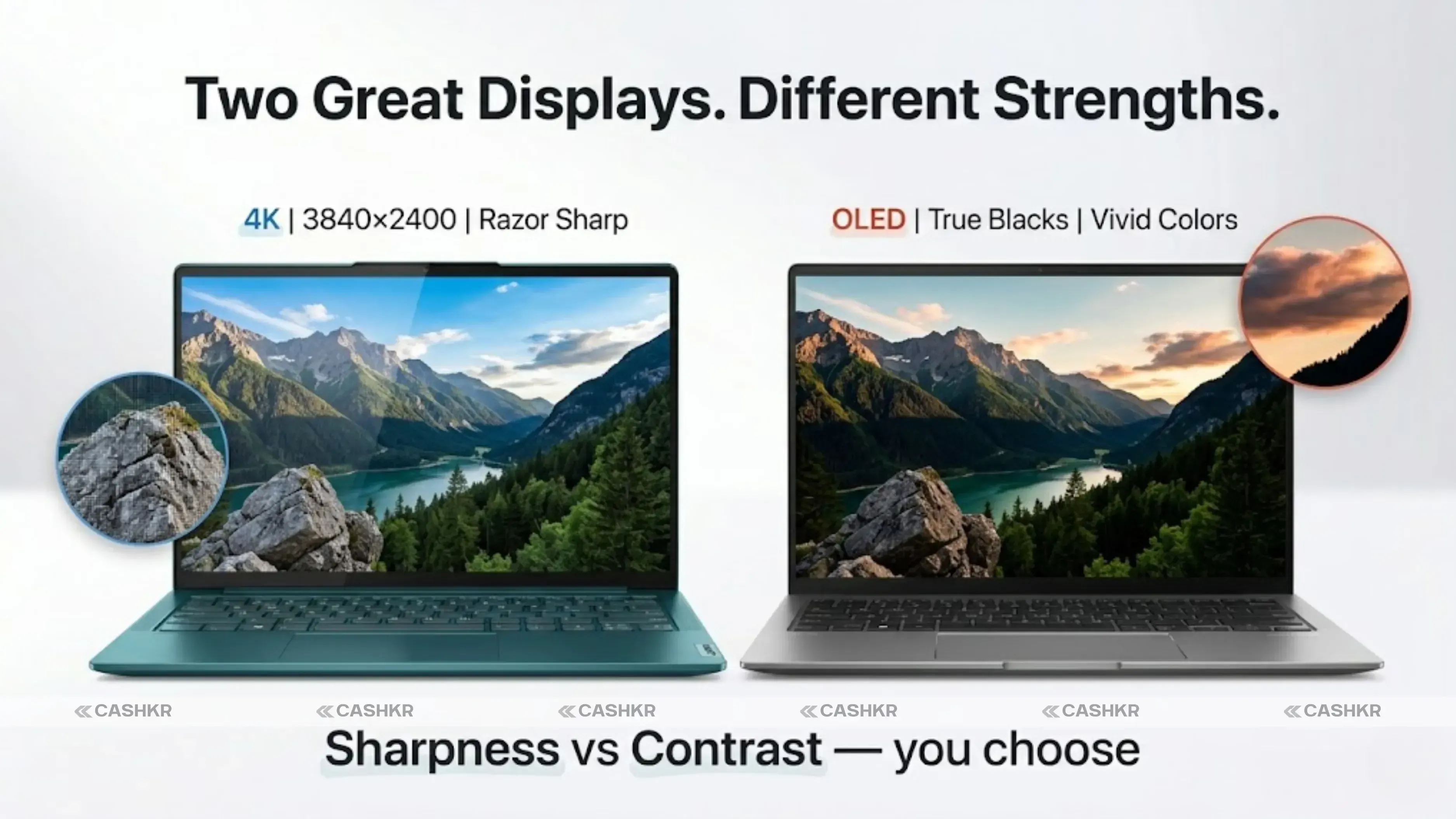
The Lenovo Yoga Slim 9i features a 14-inch display with 3840 by 2400 pixels, giving you 4K resolution on a compact screen. This means text looks crisp and photos are detailed. Its higher resolution and smaller size create outstanding pixel density, sharper than the Asus.
The Asus Zenbook S 16 OLED has a 16-inch OLED screen with a 2880x1800 resolution. While its resolution is lower than Lenovo’s 4K, the OLED technology makes a big difference. OLED screens show true blacks and vivid colors, making movies and HDR content look much better than on a regular 4K display.
The larger 16-inch screen also gives you more space for multitasking and working with several windows at once.
Your choice depends on what matters most to you. If you want the sharpest image and highest resolution, go with Lenovo. If you prefer better contrast and a bigger screen, Asus is the better pick.
Which display is right for you? If you edit photos or design graphics and need sharpness and color accuracy, Lenovo’s 4K screen is a great choice. If you watch a lot of movies or work with video, the Asus OLED panel will impress you more.
Winner: Lenovo Yoga Slim 9i on resolution and pixel density. Asus Zenbook S 16 OLED on OLED panel quality and screen size.
Performance: Asus Offers a More Powerful Processor
The Asus Zenbook S 16 OLED’s AMD Ryzen 9 HX 370 is a stronger processor than the Intel Core Ultra 7 258V found in the Lenovo Yoga Slim 9i.
The Ryzen 9 HX 370 is built for heavy workloads. It handles 4K or 8K video editing, complex simulations, large code projects, big datasets, and multitasking with demanding apps much more easily.
The Intel Core Ultra 7 258V is still a strong processor for professional tasks, Office work, web development, and daily use. It focuses more on efficiency than raw power, so it runs cooler and offers better battery life, but doesn’t reach the same performance peak as the Ryzen.
Lenovo makes up some ground with its dedicated Intel Arc GPU, which helps with tasks like moderate gaming, GPU-accelerated video rendering, and AI image generation. The Asus only uses integrated graphics.
Winner: Asus Zenbook S 16 OLED on raw processor performance. Lenovo Yoga Slim 9i has graphics with a dedicated Intel Arc GPU.
Ports and Connectivity: Asus Offers More Everyday Versatility
One of the Asus Zenbook S 16 OLED’s biggest strengths is its wide range of ports.
The Asus includes USB 4.0 Type-C, USB Type-A, HDMI, a microSD card slot, and a headphone jack. You can connect a monitor, plug in USB drives, use memory cards, and wired headphones without needing adapters. This is a real convenience if you often use external devices.
The Lenovo Yoga Slim 9i focuses on modern connections, with two Thunderbolt 4 ports for fast data and display output, plus Wi-Fi 7 and Bluetooth 5.4 for advanced wireless options. However, it lacks USB-A, HDMI, and a microSD slot, so you’ll probably need a dongle for common accessories.
If you often connect external devices, the Asus is more convenient right away. If you mostly use wireless connections or USB-C accessories, Lenovo’s Thunderbolt 4 ports and Wi-Fi 7 are better.
Winner: Asus Zenbook S 16 OLED for port variety for everyday peripherals. Lenovo Yoga Slim 9i on Thunderbolt 4 and Wi-Fi 7 speed.
Keep in mind: If you choose the Lenovo Yoga Slim 9i and often use USB-A drives, HDMI monitors, or SD cards, you’ll need to buy a USB-C hub or dongle. This adds to the overall cost.
Webcam and Extras: Lenovo Pulls Ahead
The Lenovo Yoga Slim 9i’s 32MP webcam is outstanding for a laptop. Most premium models only have 1080p webcams, even at high prices. The 32MP sensor captures much more detail, which you’ll notice in video calls, especially in low light.
The Asus Zenbook S 16 OLED has a 1080p webcam, which is good for its price, but it can’t match the quality of Lenovo’s webcam.
Lenovo also offers a fingerprint sensor for quick Windows Hello login, four speakers for better sound, and Bluetooth 5.4, which is newer than what Asus provides.
If you spend a lot of time on work video calls, Lenovo’s webcam could be the deciding factor for you.
Winner: Lenovo Yoga Slim 9i on webcam quality (32MP vs 1080p), fingerprint sensor, and audio.
Battery Life: Very Similar on Paper
Battery capacity is similar: 75Wh for Lenovo and 78Wh for Asus. On paper, Asus has a slight edge.
Real-world battery life depends on more than just battery size. The Lenovo’s Intel Core Ultra 7 is built for efficiency, which may balance out the power used by its high-resolution 14-inch screen. The Asus Ryzen 9 HX 370 is powerful but can use more energy when working hard.
For everyday mixed use, both laptops should last a full workday. With heavy tasks like video rendering, battery life will drop faster on both, but Lenovo might last a bit longer thanks to its efficient processor.
Winner: Asus Zenbook S 16 OLED has a slight edge in battery size, but Lenovo could match or beat it in real-world use.
Which Laptop Should You Buy?
Buy Lenovo Yoga Slim 9i if you travel frequently and want a light, premium laptop with a 4K display, an exceptional webcam for video calls, Wi-Fi 7, and a design that stands out.
Buy Lenovo Yoga Slim 9i if you work primarily through video calls, content consumption, and Office-style productivity rather than heavy computation.
Buy the Asus Zenbook S 16 OLED if you do heavy creative work: video editing, 3D rendering, large programming projects, or running multiple demanding apps simultaneously.
Buy the Asus Zenbook S 16 OLED if the OLED display for media consumption, a full port selection without adapters, and raw processor power are your priorities.
Consider the Lenovo if you regularly conduct video meetings and want the best webcam available in a premium ultrabook.
Consider the Asus if you want to avoid buying a USB-C hub and want to plug directly into USB-A drives, HDMI monitors, and SD cards.
Final Verdict
Neither laptop is a bad choice. Each one is designed for a different type of professional.
The Lenovo Yoga Slim 9i is the better pick if portability is your top priority. It’s lighter, has a sharper 4K display, an impressive 32MP webcam, and offers Wi-Fi 7 and Thunderbolt 4 for fast, modern connections. If you move between locations often and want a premium, portable laptop, the Yoga Slim 9i is a great choice.
The Asus Zenbook S 16 OLED is the better choice if you need more processing power, a bigger OLED display for immersive content, and a full set of ports for all your devices without adapters. For creative professionals who mostly work at a desk and need strong performance, the Zenbook S 16 is a solid option.
Bottom line: Choose the Lenovo Yoga Slim 9i for lightweight portability, sharp 4K display, and top webcam quality. Pick the Asus Zenbook S 16 OLED for its OLED screen, strong processor, and wide range of ports. It really depends on whether you travel often or need more power at your desk.
FAQs
1. Which is better, the Lenovo Yoga Slim 9i or the Asus Zenbook S 16 OLED?
Neither is universally better. The Lenovo Yoga Slim 9i is better for portability, 4K display sharpness, webcam quality, and Wi-Fi 7 connectivity. The Asus Zenbook S 16 OLED is better for raw processing power, OLED display quality, screen size, and port variety.
2. Which laptop has a better display?
Both are excellent but different. The Lenovo has a 4K resolution display at 3840 by 2400 pixels, making it sharper. The Asus has a 16-inch OLED panel with superior contrast, true blacks, and more vivid colours. For film watching, Asus wins. For sharpness, Lenovo wins.
3. Which laptop is more powerful?
The Asus Zenbook S 16 OLED with AMD Ryzen 9 HX 370 is the more powerful laptop for heavy workloads such as video editing, rendering, and large-scale computing. The Lenovo has a dedicated Intel Arc GPU, which gives it an advantage for GPU-specific tasks.
4. Which laptop is lighter?
The Lenovo Yoga Slim 9i weighs 1.25 kg, significantly lighter than the Asus Zenbook S 16 OLED at 1.50 kg. The Lenovo is the better travel laptop for users who carry their device daily.
5. Does the Lenovo Yoga Slim 9i have Thunderbolt 4?
Yes. The Lenovo Yoga Slim 9i includes two Thunderbolt 4 ports, offering fast data transfer, display output, and charging. The Asus Zenbook S 16 OLED uses USB 4.0 Type-C instead.
6. Does the Asus Zenbook S 16 OLED have an HDMIport?
Yes. The Asus Zenbook S 16 OLED includes an HDMI port, a USB Type-A port, a microSD card slot, and a headphone jack, giving it more versatile connectivity than the Lenovo Yoga Slim 9i for everyday use.
7. Which laptop has a better webcam?
The Lenovo Yoga Slim 9i has a 32MP webcam, significantly better than the Asus Zenbook S 16 OLED's 1080p webcam. For frequent video calls and remote work, Lenovo's webcam quality is a meaningful advantage.
8. Which laptop is better for video editing?
The Asus Zenbook S 16 OLED is better for video editing due to its more powerful AMD Ryzen 9 HX 370 processor and the larger 16-inch OLED display, which provides accurate colours for colour grading. The Lenovo's Intel Arc GPU can assist with GPU-accelerated rendering, but the Ryzen 9 has higher sustained performance.
9. Do I need a USB hub with the Lenovo Yoga Slim 9i?
Possibly. The Lenovo Yoga Slim 9i has two Thunderbolt 4 ports but may lack USB-A, HDMI, and a microSD slot. If you regularly use these connection types, you will likely need a USB-C hub or adapter, which adds to the effective cost.
10. Which laptop has better battery life?
The Asus Zenbook S 16 OLED has a marginally larger 78Wh battery versus the Lenovo's 75Wh. However, real-world battery life depends on usage. The Lenovo's efficiency-focused Intel Core Ultra 7 may deliver comparable or better battery life in light to moderate workloads despite the smaller battery capacity.
If you want to sell your old devices, then click here.
 Yaskar Jung ShahUpdated: Aug 8, 2026·14 min read