What Happens to Your Phone After You Sell It to Cashkr
People usually ask this for two reasons. Some want to make sure their data is erased. Others want to know their phone will not end up in a landfill.
Both questions are fair and deserve clear answers, not just reassurance. This page explains what really happens, what you need to do, and what you should ask any buyback company, including us.
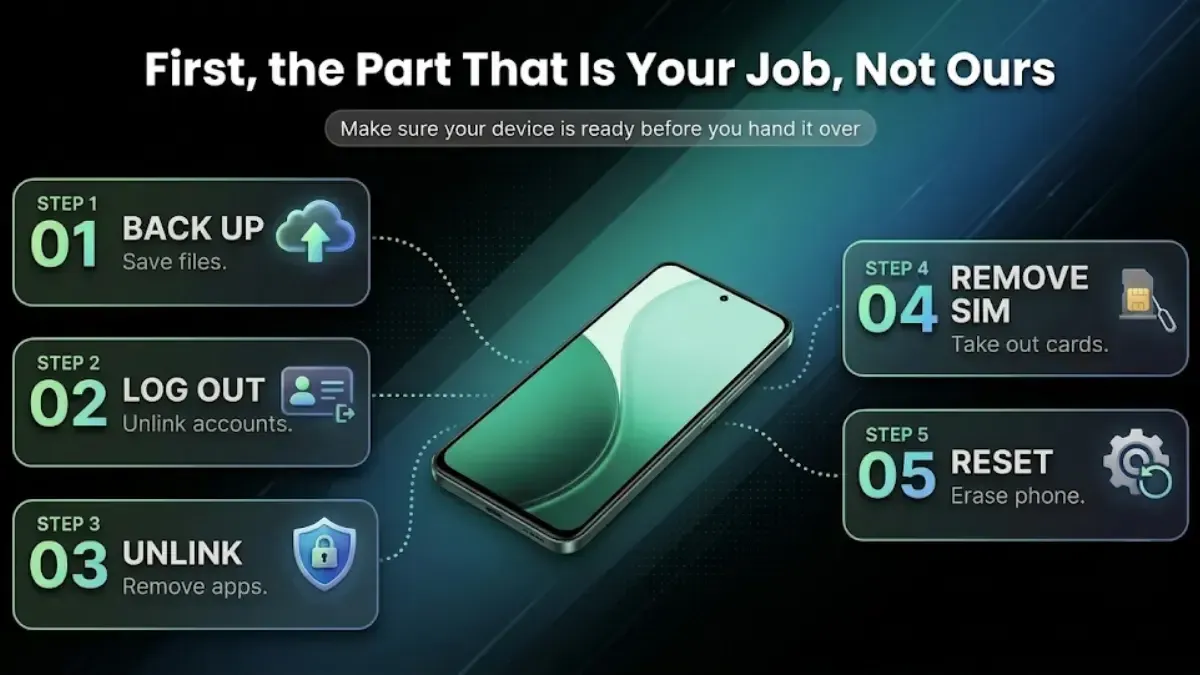
First, the Part That Is Your Job, Not Ours
You need to sign out of your accounts and factory reset your phone before handing it over. This is not because we will mishandle it, but because it is the only way you can be sure your data is safe.
Advertisement
Do it in this order:
Back up your data, and open the backup to check it worked.
Take out the SIM and memory card, and remove any eSIM.
Factory reset.
Signing out must come before the reset. If you reset while still signed in, the phone locks to your account. Factory Reset Protection on Android and Activation Lock on iPhone prevent anyone else, including us, from setting it up. This makes the phone much less valuable. This is the main reason doorstep pickups cannot be completed, even when the phone is in perfect condition.
A factory reset is enough because modern phones encrypt their storage. Android has done this by default since version 6 and required it from version 10, while iPhones have done it even longer. The reset deletes the encryption key, so anything left on the storage cannot be read.
You do not need to delete your photos first or buy special wiping software. Be cautious if someone tells you otherwise, because the factory reset is what actually protects your data.
What We Check at Collection
We check the phone’s condition based on what you described. This includes the screen, body, buttons, ports, cameras, speakers, microphone, charging, and battery health. The inspection matches your description, so being honest helps you keep the quote you received.
We also check if the phone is clear to resell. This is more important than many people think, and there is a government system in India you can use to check this yourself.
The Department of Telecommunications runs the Central Equipment Identity Register on the Sanchar Saathi portal. Its IMEI verification service, also called Know Your Mobile, tells you a handset's manufacturer, model and current status.
How to check any phone yourself:
Dial *#06# to get the 15 digit IMEI.
Send an SMS reading KYM 123456789012345, with your IMEI, to 14422. Or use the IMEI verification page at ceir.sancharsaathi.gov.in.
If the status shows blacklisted, duplicate, or already in use, the portal advises against buying that phone. It is a good idea to check this before buying any second-hand phone from a private seller, and it only takes about a minute.
The same portal is where you report a phone as lost or stolen, which blocks it on every network in India. It is also where you unblock one that turns up again, after reporting it to the police.
What Happens Next
After inspection, a phone can go one of three ways, depending on its condition.
Refurbished and resold. A phone that works, or that needs repairs worth making, is cleaned, repaired, tested and sold on. This is where most devices in good condition end up, and it is the outcome everyone wants. A working phone kept working beats a recycled one by every measure.
Harvested for parts: Many people do not expect this, but it is why we buy phones that will not turn on. A non-working phone can still provide screens, cameras, batteries, boards, and other parts to repair other phones. The phone itself is gone, but most of its parts are reused.
Sent for materials recovery: Anything left over, or too damaged to use, is recycled. This process recovers copper, aluminum, gold, and plastics.
The order matters: reuse comes first, then parts, and finally materials. Sending a working phone straight to recycling destroys value and is not responsible.
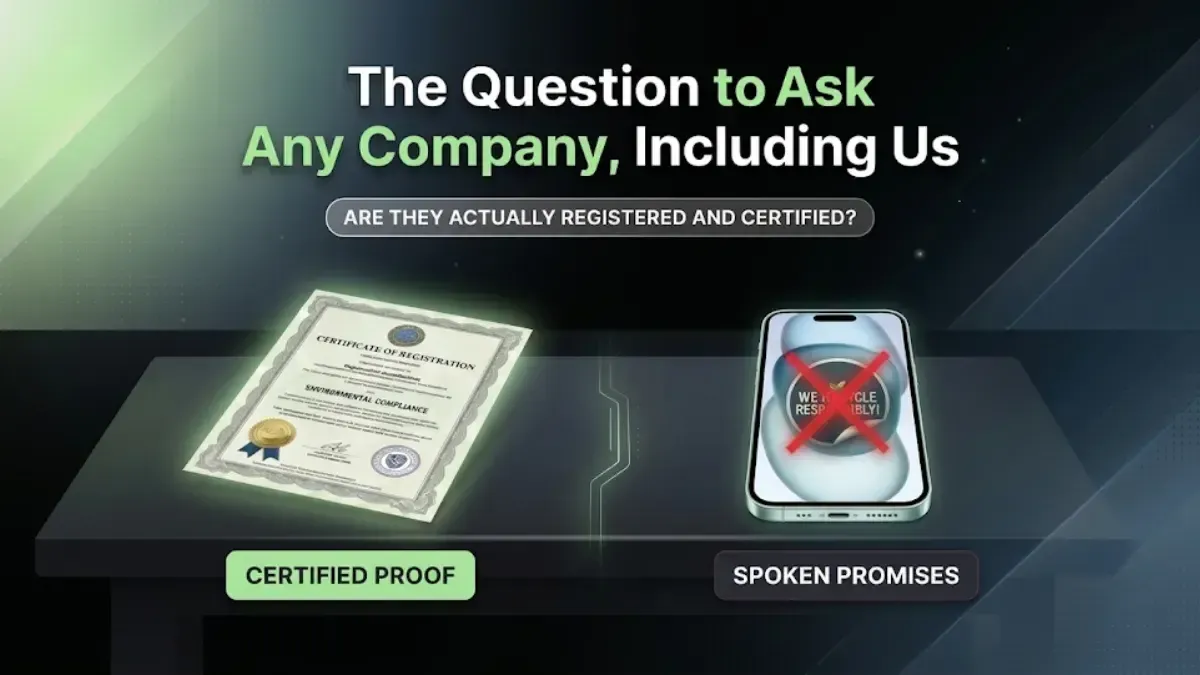
The Question to Ask Any Company, Including Us
Most pages simply say "we recycle responsibly" and leave it at that. But that phrase alone does not mean much, so here is what you should ask instead.
Under the E-Waste (Management) Rules, 2022, a refurbisher in India has to be registered with the Central Pollution Control Board. Registration goes through the CPCB's EPR portal and lasts five years. It requires the company's facility details, its state pollution board consents, and a geo-tagged video of its plant. CPCB can revoke it for up to three years for supplying false information.
And a registered business is not allowed to deal with an unregistered one. The rules prohibit registered entities from dealing with unregistered producers, recyclers or refurbishers.
So there is one question that cuts through every green claim on every buyback site in India:
"What is your CPCB registration number, and who are the registered recyclers you hand devices to?"
A company that handles devices properly can answer this question easily. If they cannot, that tells you something important.
Ask us. Ask other companies too. This is a better test than any logo or slogan.
[INSERT HERE: Cashkr's CPCB refurbisher registration number, and the names and registration numbers of the recyclers Cashkr hands devices to. This page should not be published without them. See the notes at the end.]
Our guide on recycling old devices in India explains what the rules require of households, producers and recyclers, and how to find a registered recycler near you.
What We Are Not Going to Tell You
Two things, because other pages promise them and should not.
We cannot tell you where your specific phone ends up. After you are paid, your phone is graded and processed with others, and it is no longer linked to your name. Any company promising updates on your old phone’s journey is not being truthful. It would be unusual if they could.
We will not claim to check your phone for leftover data. If a company says its staff check for your personal data, it means they can see your personal data.
The honest position is the one at the top of this page. You sign out, you reset, and the encryption key is destroyed in the process. That is what makes your data safe, and it is in your hands rather than ours by design.
Why Selling Beats the Drawer
A phone left in a drawer does not help anyone. It loses value each month, its battery ages even if unused, and eventually it becomes something you need to throw away instead of something valuable.
1. What happens to my phone after I sell it to Cashkr?
It is inspected against the condition you described and checked to confirm it is clear to resell. From there it goes one of three ways. A phone that works, or is worth repairing, is refurbished and sold on. A phone that cannot be revived is harvested for working parts that repair other phones. Whatever is left goes for materials recovery.
2. Is my data safe after I sell my phone?
It is, provided you do two things before the phone leaves you: sign out of your Google or Apple account, then factory reset it. Modern phones encrypt their storage and the reset destroys the encryption key, so what remains cannot be read. Do not rely on anyone else to do this for you.
3. Do I need to delete my photos or buy wiping software first?
No. Deleting files removes the signpost rather than the file, and the factory reset is what does the real work on an encrypted phone. Multi-pass wiping software is a hard drive technique and does not transfer to phone storage.
4. Why do I have to sign out before resetting?
Because resetting while signed in locks the phone to your account. Factory Reset Protection on Android and Activation Lock on iPhone both stop anyone else setting the phone up, including us. A locked phone is worth a fraction of an unlocked one.
5. How can I check whether a used phone is stolen?
Dial *#06# for the IMEI, then send an SMS reading KYM followed by that 15 digit number to 14422, or use the IMEI verification page on the government's Sanchar Saathi portal. It returns the make, model and status. If it comes back blacklisted, duplicate or already in use, the portal advises against buying it.
6. Will you tell me where my old phone ended up?
No, and nor can anybody else honestly. Once you have been paid, the handset is graded and processed with others and is no longer linked to you. Any company promising updates on your old phone's journey is describing something that does not happen.
7. What happens to a phone that cannot be repaired?
It is taken apart for parts that still work, which go into repairing other phones. Screens, cameras, batteries and small components all have a second life. What is left after that goes for materials recovery, where metals and plastics are recovered.
8. How do I know a buyback company disposes of devices properly?
Ask for its CPCB registration number and the names of the registered recyclers it hands devices to. Under the E-Waste (Management) Rules, 2022, a refurbisher in India must be registered with the Central Pollution Control Board, and a registered business is not permitted to deal with an unregistered one. A company that handles devices properly can answer that question in a line.
9. Is selling my old phone actually better for the environment than recycling it?
Usually yes, if it still works, because keeping a working device in use avoids the manufacture of a replacement entirely. Recycling recovers materials, which is good, but it is the last step rather than the first. Reuse, then parts, then materials.


 Yaskar Jung ShahPublished at: Jun 24, 2025·12 min read