OpenAI AI Device: Everything We Know About the Jony Ive Collaboration
Let’s be honest. When you hear that OpenAI is building a piece of hardware, it sounds a bit strange at first. A company famous for ChatGPT, the chatbot that took the world by storm, suddenly wants to make a gadget? But when you dig a little deeper, it actually makes perfect sense. And when you factor in that they’re working with Jony Ive, the guy who designed the iPhone, things get genuinely exciting.
Artificial intelligence has already transformed how we search, work, communicate and even think about technology. But here’s the thing: we’re still accessing all that AI power through devices that were developed long before AI was this powerful. Apps, touchscreens, keyboards, and menus were built into smartphones, tablets, and computers. They weren’t created for a world where you can just talk to a machine like it’s a person and expect it to genuinely get you.
That’s why the OpenAI AI Device is causing such a stir. This is neither another smart speaker or a weird wearable. This might be the first consumer electronics item to put artificial intelligence front and center. Not as an added feature you sometimes use, but as the very reason the device exists in the first place.
So, what do we actually know? Let’s break it all down, the rumours, the potential features, the challenges, and whether this thing could actually live up to the hype.
Why Is OpenAI Building Hardware in the First Place?
If you’ve used ChatGPT on your phone, you already know it works pretty well. So why bother building dedicated hardware?
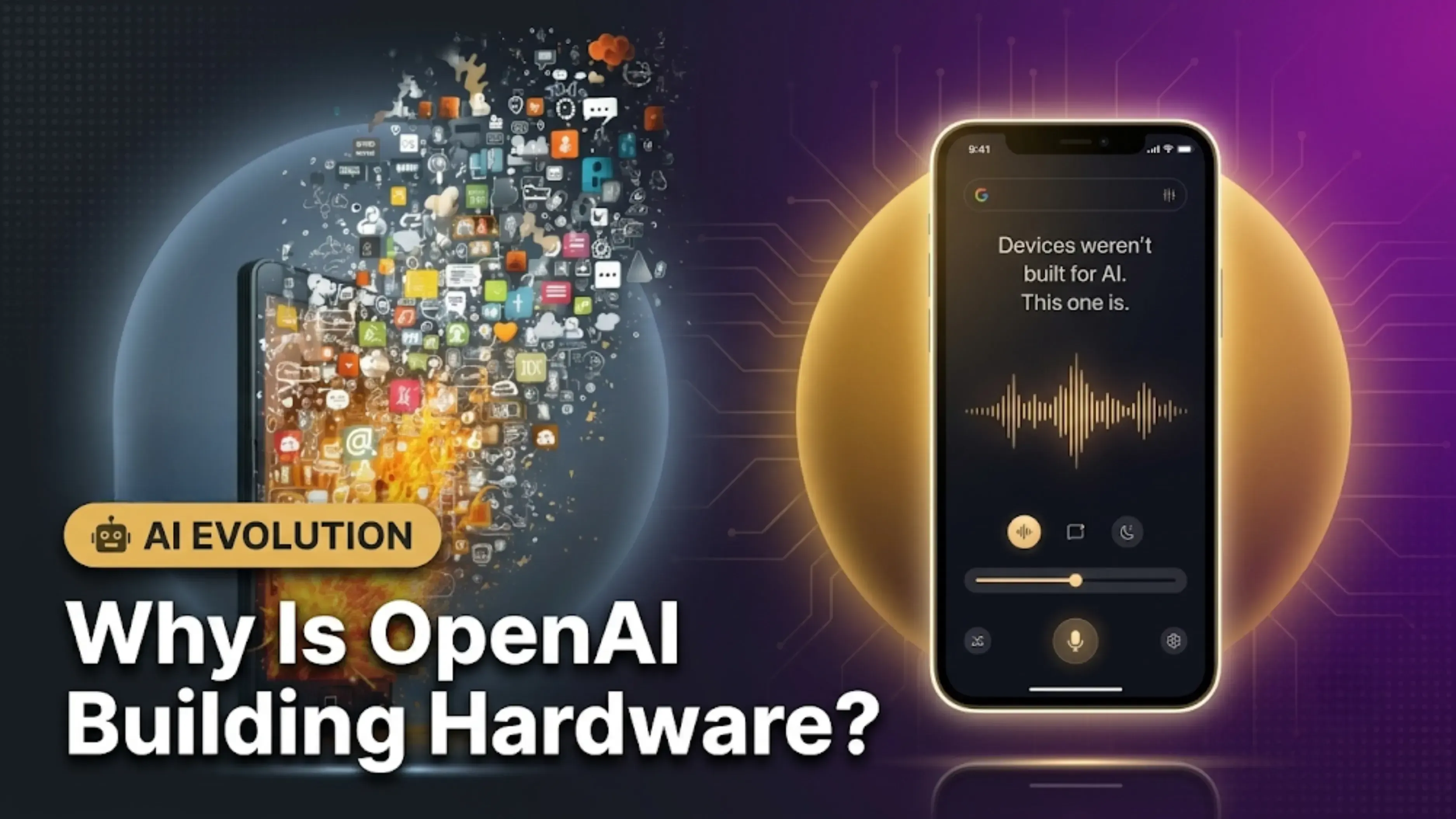
The answer is simple: our current devices were never built for AI. They were built for apps. Every time you want to do something, you unlock your phone, find the right app, tap through menus, type something, and wait. It’s a friction filled experience that feels increasingly outdated when you consider what AI can actually do today.
OpenAI appears to believe that artificial intelligence deserves a platform of its own, a gadget with which you need not “open” anything. You just talk and it replies. You ask and it responds. No swiping, no tapping, no hunting out the proper icon.
With a dedicated OpenAI hardware device, the company could deliver:
Faster, more responsive AI interactions. A deeply personalised assistant that actually knows you. Context aware suggestions that feel intuitive, not creepy. Better productivity tools for work and life. An experience that feels more like a conversation and less like using a computer.
This isn’t about building another gadget. It’s about rethinking how humans and machines collaborate. And that’s a much bigger ambition.
Why Jony Ive’s Involvement Is a Big Deal
Whenever Jony Ive’s name pops up, the tech world pays attention. And for good reason.
As Apple’s former Chief Design Officer, Ive was the creative force behind some of the most iconic products in history, the iPhone, iPad, MacBook, Apple Watch, and AirPods. His design philosophy has always been about simplicity, elegance, and stripping away anything that doesn’t serve a purpose.
So why does that matter for the Jony Ive OpenAI device?
Because hardware is hard. Making something that feels good to use, looks beautiful, and actually works reliably is a rare skill. OpenAI has the brains when it comes to AI, but Ive brings the soul. His involvement suggests that this won’t be some clunky prototype or a boring black box. It’s going to be something people actually want to hold, wear, or keep on their desk.
The OpenAI and Jony Ive partnership is already one of the most spoken about collaborations in the IT world. And do you know what? You can see why. You have the company that built the world’s most powerful AI model teaming up with the designer who created contemporary consumer electronics. That is a potent combo.
What Do We Actually Know About the OpenAI AI Device?
Official details are still thin on the ground. OpenAI hasn’t confirmed much, and Ive’s team at LoveFrom has been characteristically secretive. But enough reports and leaks have surfaced to give us a pretty good picture.
A Screenless or Screen Light Experience
One of the most persistent rumours is that the OpenAI screenless device will move away from traditional displays. Instead of staring at a screen and tapping away, you’ll interact through natural conversation.
Imagine this: If AI is clever enough to know what you need, do you need the screen at all? You talk. It hears. You ask, it answers. You tell it what you want it to do. This direction is in good agreement with the OpenAI objective of democratizing AI and making it more natural.
Another may be a screen lite experience that reduces distractions. You’d be paying attention to the conversation and the task at hand, not continuously staring at a luminous rectangle. That's a welcome respite from the attention economy we all are stuck in.
AI at the Core
Unlike smartphones, where AI is just another feature tucked inside an app, the OpenAI AI companion will put intelligence at the centre of everything.
We’re talking about natural conversational assistance, intelligent task and schedule management, real time information retrieval, proactive personalised recommendations, and smart reminders that actually make sense.
This wouldn’t feel like using a gadget. It would feel more like having a helpful, knowledgeable companion by your side.
Context Aware Intelligence
Another exciting possibility is that the device will use sensors, microphones, and cameras to understand its surroundings. This context aware AI could allow it to recognise where you are and what you’re doing, offer relevant suggestions at the right moment, and anticipate your needs before you even ask.
For instance, if you’re in the kitchen, it might recommend recipes. If you’re sitting at your desk, it might help you to focus or prioritise work. That kind of intelligence would make today’s virtual assistants seem rudimentary.
Deep ChatGPT Integration
This one’s almost guaranteed. The device will almost certainly feature seamless integration with ChatGPT.
Imagine being able to continue a conversation from your phone, right on the device. Or accessing AI assistance instantly, without unlocking anything. Or managing your entire workday through natural voice commands.
The result could be a connected AI ecosystem where everything works together, powered entirely by OpenAI’s technology.
Will the OpenAI Device Replace Smartphones?
This is the million dollar question. And the honest answer is: probably not, at least not yet.
Smartphones do a lot of things. They handle calls, messaging, photography, navigation, mobile banking, entertainment, and social media. Replacing all of that would be incredibly difficult.
But that doesn’t mean the OpenAI AI device can’t become a valuable companion. Think of it as a dedicated assistant that handles the stuff smartphones aren’t great at, like managing your schedule, answering complex questions, or helping you stay focused.
Over time, as AI continues to evolve, we might rely less on traditional apps and more on intelligent assistants. But for now, the device will likely complement your phone rather than replace it.
So, will OpenAI replace smartphones? Not anytime soon. But it could definitely change how we use them.
How Does It Compare to Other AI Devices?
OpenAI isn’t the first company to try this. Several others have jumped into the AI hardware market with varying degrees of success.
Humane AI Pin
The Humane AI Pin generated a ton of hype with its vision of screen free computing. But when it actually launched, many users found it struggled with performance, battery life, and basic usability. It was a bold idea, but the execution fell short.
Rabbit R1
Another fun try was Rabbit R1, a small assistant that was meant to do things for you. It was creative, but also a reminder of how tough it is to make hardware that offers actual, lasting value.
OpenAI’s Advantage
This is where the OpenAI AI Device has a clear edge. Unlike its competitors, OpenAI already has a massive, loyal user base, industry leading AI models, incredible brand recognition, deep financial resources, and access to world class design talent through Jony Ive.
These advantages could help OpenAI avoid the pitfalls that tripped up Humane and Rabbit. If anyone can crack the code on AI hardware, it’s probably this team.
Potential Use Cases for the OpenAI AI Device
Assuming OpenAI delivers on its vision, the device could be useful in a bunch of everyday scenarios.
Personal Assistant
Managing your schedule, setting reminders, and organising your day through natural voice commands. No more fiddling with calendar apps.
Productivity Tool
Professionals may write emails, summarise meetings, arrange projects and do research all through conversation.
Educational Companion
Students could get instant explanations, language learning assistance, study support, and quick knowledge retrieval.
Smart Home Controller
The device could integrate with smart home systems, letting you control lights, thermostats, and security systems with your voice.
What Does This Mean for Consumers?
Every major shift in technology changes consumer behaviour. When smartphones became mainstream, people started upgrading their devices at an unprecedented rate. The same thing could happen with AI first hardware.
As the OpenAI device launch approaches, consumers may start thinking about replacing older gadgets with AI native alternatives. This could drive demand for trade ins and buyback services.
Platforms like Cashkr are already making it easier for people to sell their old phones, laptops, tablets, smartwatches, and Macs quickly and conveniently. As next gen AI hardware becomes more common, consumers will likely look for simple ways to unlock value from their existing electronics before upgrading to the latest technology. It’s a natural part of the cycle, sell what you don’t need, invest in what’s next.
Challenges OpenAI Must Overcome
All the joy notwithstanding, the path ahead is bumpy.
Privacy Concerns
Any device with microphones, cameras, and sensors is going to raise privacy questions. OpenAI will need to be transparent about how data is collected, stored, and used. Trust will be everything.
Consumer Adoption
The love of smart phones. Getting them to switch to a whole new computer model will need obvious, convincing benefits. It can’t only be cool, it needs to be useful.
Battery Performance
AI processing is power hungry. Efficient battery management will be critical. No one wants a device that dies halfway through the day.
Pricing
The device needs to offer enough value to justify its cost. When consumers already own powerful smartphones, the pricing has to make sense.
The Future of AI Hardware
The OpenAI AI Device isn’t just a product. It’s part of a larger push toward voice first computing and AI powered devices that seem less like tools and more like friends.
In the future, users won’t need to open apps and type in searches. Instead, they’ll only talk to intelligent assistants that comprehend context, preferences and purpose. It’s a move away from “using” technology to “talking” to it.
Regardless of whether the first OpenAI consumer hardware device is a success or not, this is an important moment. More and more companies are trying to figure out how AI may be the major interface between humans and machines.
If OpenAI and Jony Ive can successfully combine cutting edge artificial intelligence with exceptional design, they might just create one of the most influential products of the decade. It’s a big bet, but if anyone can pull it off, it’s this duo.
Final Thoughts
The OpenAI AI Device is quickly looking to be one of the most intriguing technology debuts in recent memory. Jony Ive’s famed design philosophy mixed with the AI expertise of OpenAI has sparked massive anticipation.
Yes, there are still plenty of unknowns. But the vision is becoming clearer: a future where AI is the primary way we interact with technology, natural, intuitive, and always helpful.
Whether the device becomes a smartphone companion or an entirely new computing platform, its launch could influence how we use technology for years to come.
As innovation progresses at a rapid pace, many customers will soon be moving to AI-first products and seeking for simple ways to sell their existing electronics. Platforms like Cashkr can help make that move easier, giving a quick means to extract value from obsolete electronics before moving on to the new generation of equipment.
Over the next few years we’ll see if OpenAI’s hardware ambitions will shake up consumer technology as much as ChatGPT has changed artificial intelligence.
FAQ’s
1. So, what exactly is this OpenAI device everyone’s talking about?
Advertisement
It’s a rumoured piece of hardware that OpenAI is developing with Jony Ive. The idea is to create something that puts AI front and centre, not as an app or a feature, but as the main way you interact with it.
2. When is the OpenAI device actually coming out?
Nobody knows for sure. OpenAI hasn’t announced anything officially, but the rumour mill says we might hear something soon. Take that with a grain of salt though.
3. Is this thing going to replace my smartphone?
Not right away. It’s more like a friend that takes care of the things your phone isn’t so good at, like keeping up with your calendar or having a real chat with you. But could it one day replace your phone? Perhaps. But not now.
4. Wait, who’s Jony Ive again?
He’s the designer who creates the look and feel of the iPhone, iPad, Apple Watch and many other Apple devices. He departed Apple a few years ago and is now running his own design company. His involvement is huge. He’s incredibly adept at making technology feel human.
5. How is this different from that Humane AI Pin thing?
Good question. The Humane Pin had a similar idea, no screen, just voice and gestures. But it kinda flopped because it wasn’t that useful in real life. OpenAI has better AI, more money, and way more users, so they might actually pull it off.
6. And what about the Rabbit R1?
Another fascinating attempt was the Rabbit R1. This small orange thing, that may do things for you. Cool idea but had the same problem, it didn't truly give consistent value. “We hope to learn from those mistakes,” says OpenAI.
7. Will it use ChatGPT?
Almost certainly. It would be weird if it didn’t, right? The whole point is deep integration with OpenAI’s AI models.
8. What kind of features are we talking about?
Think voice interaction, smart scheduling, real time answers to questions, personalised recommendations, and maybe even smart home control. Basically, a personal assistant that actually works.
9. Do I have to worry about privacy?
You should always worry about privacy with any device that has a microphone or camera. OpenAI will need to be really transparent about how they handle data. We’ll have to wait and see.
10. Is this actually going to be successful?
Seriously, who knows? The hardware market is a bloodbath. But if anyone’s got a shot, it’s OpenAI. They have the AI, the design talent and the funding to build something remarkable. I’m cautiously hopeful.
Get a free resale estimate from CashKr and see how much your current device is worth — whether you're upgrading to the OpenAI AI Device or just staying ahead of the tech curve.