BSNL Satellite Phone Explained: Price, Specifications, Features & Everything You Need to Know
For the longest time, satellite communication felt like something straight out of a spy movie. Military ops, deep-sea rescues, or disaster zones. But when BSNL recently launched its satellite phone, suddenly everyone in India started talking about it. And honestly? A lot of people got confused. Many assumed BSNL had dropped some futuristic satellite-powered smartphone that would blow iPhones and Androids out of the water. But that’s not quite what happened.
What BSNL actually introduced is something much more specialized, and in many ways, much more important.
Unlike your everyday smartphone that lives and dies by the nearest 4G or 5G tower, the BSNL satellite phone completely bypasses ground infrastructure. It talks directly to satellites orbiting high above the Earth. That means you can make calls and send messages from places where your regular phone would just show that dreaded “No Service” message. We’re talking dense forests, towering mountain ranges, deep-sea vessels, or disaster-hit regions where mobile towers are either down or non-existent.
So if you’re curious about what this device really is, how much it costs, who it’s for, and whether it makes sense for you, stick around. Let’s break it all down in plain, simple language.
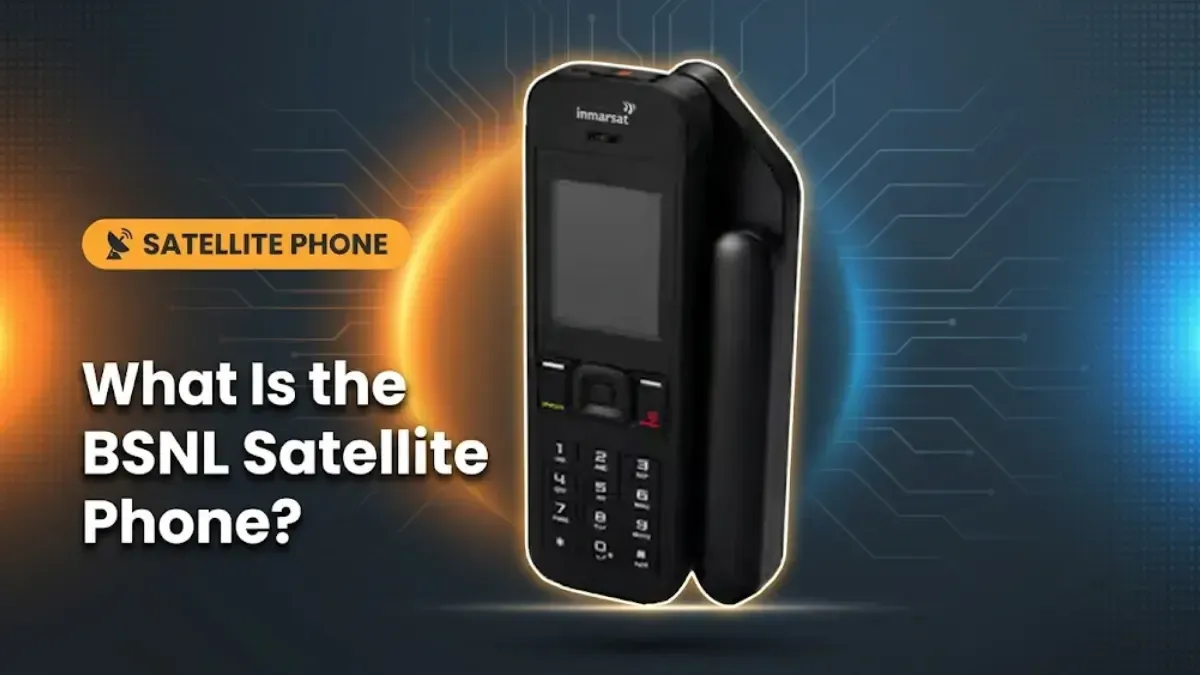
What Is the BSNL Satellite Phone?
Let’s just clear one thing up right now. This is not a smartphone; this is a BSNL satellite phone. It is a purpose-created communication tool that is not reliant on cellular networks but is completely reliant on satellite connectivity. Rather than looking for nearby towers like your typical phone, this small beast looks up, literally, and connects to satellites zipping overhead.
BSNL has built this service keeping some specific consumers in mind. This includes defense troops, emergency response teams, forest officers, shipping workers, mining operators, researchers, and enterprises operating well outside the reach of civilization. These are people who can’t afford to be out of touch just because they are in the middle of nowhere.
This is not a device to scroll Instagram or watch YouTube. It has one job. Only one job. To provide you with a reliable lifeline of communication when all other networks fail. And in an emergency, that one job can be the difference between life and death.
How Does a Satellite Phone Work
To really appreciate what this phone does, it helps to understand the “how” behind it.
Your regular smartphone is basically a tower hunter. It constantly scans for the nearest mobile tower, and when you’re within range, you get a signal. Step outside that coverage zone, and poof, your phone becomes a very expensive paperweight.
A satellite phone, on the other hand, doesn’t care about towers. It sends signals straight up to geostationary satellites hovering thousands of kilometers above the Earth. These satellites then relay your communication to ground stations, which route your call or message to its destination.
Because satellites cover massive swathes of the planet, you can stay connected from places like high-altitude mountain passes, thick jungles and forests, remote villages with zero tower presence, arid desert zones, ships in the middle of the ocean, sensitive border areas, and regions hit by earthquakes, floods, or cyclones.
The ability to communicate without mobile towers is what makes satellite communication such a game-changer, especially in a country as geographically diverse as India.
BSNL Satellite Phone Specifications
Now let’s talk specs. If you're expecting retina displays and 200MP cameras, you'll be disappointed. But if you value longevity and dependability, this phone performs where it matters.
Specification
Details
Network
Inmarsat Satellite Network
Connectivity
Satellite Communication
Voice Calling
Yes
SMS
Yes
GPS
Built in GPS Receiver
Emergency SOS
Dedicated SOS Button
Compared to a flagship smartphone, these stats might look tiny, but given the environment this device is designed for, they are very impressive. It’s not supposed to win beauty contests. It’s built to survive the outdoors and keep you connected when it matters.
This is the big attraction. Even without a single cell tower in sight, you can make crystal-quality voice calls with the BSNL satellite phone. Whether you’re mounting a peak in the Himalayas or working on a rig hundreds of kilometers from shore, satellite voice calling means you’re never really out of reach.
SMS Communication
Sometimes all you need is a quick SMS, and this phone has you covered there as well. It's not iMessage or WhatsApp, but SMS over satellite is extremely reliable — especially in emergency situations where every byte of data is precious.
Built-in GPS Tracking
It’s no fun getting lost, especially in a strange place. This phone has an in-built GPS, so you will always know exactly where you are and can tell others. That’s a blessing for rescue teams, exploration teams, surveyors, and maritime staff. Knowing your coordinates can significantly cut down emergency response time.
Dedicated SOS Emergency Button
This is one of the most soothing aspects. In a crisis, you don’t want to be fumbling through menus. You want action *right now*. Thanks to a dedicated SOS button, you can communicate your GPS coordinates to a preset emergency contact with the push of a single button. For those who operate in isolated or high-danger areas, this is not a luxury. This is a must.
Long Battery Life
Modern smartphones barely last a day without a charge. The BSNL satellite phone is built differently. With up to 8 hours of talk time and a staggering 160 hours of standby, it can easily outlast your weekend trek or multi-day emergency situation where power outlets are a distant dream.
Rugged Design
This phone is not fragile. It's designed to be sturdy, dust-resistant, splash-proof, and can take a little rough and tumble. Whether you’re on a building site, facing sea spray on a fishing boat, or hiking uneven ground, the tough construction means your communication lifeline isn’t going anywhere.
Reliable Communication During Emergencies
Mobile networks are often the first to go when tragedy strikes. Towers topple, wires break, networks jam. But satellite phones don't rely on ground-based infrastructure, so they keep operating when everything else doesn't. That reliability is not only convenient for emergency responders. It’s mission-critical.
Why Isn’t It a Smartphone?
I get it. When you hear “BSNL satellite phone,” your brain might jump to a futuristic hybrid that does everything. But that’s not what this is.
The BSNL satellite phone is a specialized tool, not a multimedia powerhouse. It does not come with an Android or iOS operating system, an app store or Google Play, social media apps, high-end cameras, streaming services, 5G internet browsing, or gaming capabilities.
It’s not attempting to be your everyday driver. It’s meant to be your security blanket when you’re off the grid. If you reside in a city with good 4G and 5G connectivity, you are considerably better off with a regular smartphone. But this is an essential item for professionals working in areas where cellular networks don't reach.
BSNL Satellite Phone Price and Availability
Alright, let’s talk money, because this is where things get real.
The BSNL satellite phone price is approximately ₹1,34,166. That’s a significant chunk of change, especially when you consider that it doesn’t do half the things your current smartphone does. On top of that, you’ll need to subscribe to BSNL’s satellite service, with calls costing roughly ₹18 per minute, depending on your plan.
So why so expensive? Because satellite communication isn’t cheap. Unlike mobile networks that use thousands of ground-based towers, satellite phones rely on dedicated satellites orbiting the planet, infrastructure that costs a fortune to build and maintain. That cost gets passed on to the user.
At this point, this product is not targeting the typical consumer. It is aimed at government agencies, defense units, disaster management teams, maritime operators, and enterprises that really need communication in remote locations where there is no mobile service.
Advertisement
Who Should Buy the BSNL Satellite Phone?
Let's face it. Most of us don’t need a sat phone. If you reside in the city and you travel to work with reliable 4G coverage, you might as well keep on your ordinary smartphone. For certain folks, however, this gadget is a real game-changer.
The BSNL satellite phone is ideal for defense and border security personnel, disaster management and emergency response teams, mountaineers and trekking expedition leaders, forest officers and wildlife researchers, maritime professionals and fishermen operating offshore, mining, oil, and gas industry workers, infrastructure teams working in remote regions, and scientific researchers conducting field studies in isolated areas.
For these users, the ability to make satellite voice calls and send messages from anywhere isn’t a luxury. It’s a safety requirement.
BSNL Satellite Phone vs Regular Smartphone
If you’re still wondering whether this device can replace your smartphone, the answer is a clear no. They serve entirely different purposes, and comparing them side by side makes that obvious.
Feature
BSNL Satellite Phone
Regular Smartphone
Network
Satellite
4G / 5G Mobile Network
Coverage
Remote areas without towers
Areas with cellular coverage
Voice Calling
Yes
Yes
SMS
Yes
As you can see, the BSNL satellite phone isn’t competing with your smartphone. It’s complementing it. It fills the gap when your regular phone can’t.
Why would anyone choose this over a regular phone? Here’s why.
It operates even outside of cell network coverage. No towers ? No worries. This phone keeps you connected where your ordinary phone wouldn’t work.
It’s good for natural calamities. When floods, earthquakes, or cyclones take down mobile infrastructure, satellite connectivity remains up and running.
It improves safety. GPS tracking and the SOS button add a layer of security that’s hard to overstate, especially in high-risk environments.
It has rugged construction. Built to withstand dust, splashes, and rough handling, perfect for outdoor and industrial use.
It offers long battery backup. With up to 160 hours of standby, you can go days without worrying about finding a charger.
Limitations of the BSNL Satellite Phone
Of course, it’s not all sunshine and roses. This device has its drawbacks too.
The initial cost is high. At over ₹1 lakh, it’s more expensive than most premium smartphones on the market.
Calling charges are expensive. At ₹18 per minute, you’re not going to be chatting casually with friends or family.
There’s no smartphone experience. No apps, no social media, no cameras, no games, just pure, functional communication.
Consumer use is limited. For city dwellers with good network coverage, the device offers little practical benefit.
The Future of Satellite Connectivity in India
The BSNL satellite phone launch is more than just a product announcement. It's a sign of where we're headed. Telecom corporations and IT giants around the world are pouring billions into satellite connectivity to help close the digital divide in remote and neglected regions.
Some luxury smartphone models are already getting satellite-based emergency capabilities added by smartphone companies. While still rather basic compared to specialist satellite phones, they do hint at a future where satellite connectivity becomes a normal fallback option.
In the coming years, expect satellite networks to complement, not replace, our existing 4G and 5G infrastructure. That combination could give users a lot more peace of mind, especially when traveling off the beaten path or during unexpected emergencies.
For now, the gold standard remains specialized devices like the BSNL satellite phone for professionals who need uninterrupted contact beyond the reach of cell towers.
Final Thoughts
The BSNL satellite phone is a big leap forward in communication in the remotest areas of India. Not for everyone. Nor is it attempting to be. But it’s an absolute lifeline for those that really need it – defense personnel, emergency responders, mountaineers, researchers, and maritime professionals.
With satellite voice calling, SMS, GPS tracking, an SOS button, rugged construction, and phenomenal battery life, this device prioritizes one thing above all else. Reliability. Yes, the price is steep, and the call rates aren’t cheap. But when you’re in a life-or-death situation with zero mobile coverage, that cost suddenly feels very small.
As satellite technology keeps becoming better, we are likely to see even more powerful features make their way down to regular handsets. But until that day arrives, dedicated satellite phones remain the most reliable option for connection in isolated areas.
Thinking About Upgrading Your Smartphone?
Satellite phones are fascinating, but let’s be real. Most of us are still going to be using regular smartphones for the foreseeable future. And if you’re planning to upgrade to a newer model, don’t let your old device collect dust in a drawer.
That’s where Cashkr comes in. With Cashkr, you can sell your old phone online in just a few simple steps. Get a competitive price, enjoy free doorstep pickup, receive instant cash for your old phone, and rest easy knowing your data is handled with secure data deletion. Selling before your phone loses more value is a smart way to make your smartphone upgrade more affordable, and with old phone resale through Cashkr, the process is smoother than ever.
So whether you’re eyeing the latest flagship or just want to clear out some clutter, Cashkr makes selling your old phone online quick, safe, and hassle-free.
Frequently Asked Questions
1. What is the BSNL satellite phone?
BSNL satellite phone is a special communication gadget that uses satellite connectivity instead of conventional mobile towers. This isn't like a normal smartphone that connects to the internet over a 4G or 5G network. Instead, it connects directly to satellites orbiting the Earth. This means users can make satellite phone calls and send messages from remote regions where there is no cell network coverage at all. It is intended for use by professionals like defense personnel, emergency response teams, mountaineers, and maritime workers who need dependable communications outside the reach of cellular towers.
2. How does the BSNL satellite phone work?
BSNL satellite phone operates by avoiding the ground-based mobile towers altogether. The cellphone delivers signals straight to geostationary satellites hundreds of kilometers above the Earth instead of talking to nearby cell towers. The satellites then send your voice calls and messages to ground stations, which link them to the recipient. This allows satellite communication even in impenetrable forests, high mountain ranges, offshore vessels, or disaster-stricken locations where mobile networks are inaccessible or completely damaged.
3. What are the BSNL satellite phone specifications and price?
The BSNL satellite phone specifications include an Inmarsat satellite network, a built-in GPS receiver, a dedicated SOS button, up to 8 hours of talk time, 160 hours of standby battery, a rugged, dust- and splash-resistant body, and a sunlight-readable display. As for the BSNL satellite phone price, it is approximately ₹1,34,166. In addition to the handset cost, users need to subscribe to BSNL’s satellite service, with voice calls typically costing around ₹18 per minute depending on the selected plan.
4. Can a satellite phone work without a mobile network?
Yes, certainly. That’s actually what a satellite phone is for. A satellite phone does not need a mobile network, as it does not rely on terrestrial towers at all. Instead, it talks directly to satellites that are orbiting. So even if you are in the middle of a desert, deep in the center of a forest, or in an area where a natural disaster has taken down every single cell tower, your satellite phone will still work. It is designed for communications that do not need cell towers.
5. BSNL satellite phone vs smartphone: what’s the difference?
The comparison between a BSNL satellite phone and a smartphone demonstrates that they are designed for very different purposes. A smartphone depends on 4G or 5G mobile networks and provides apps, cameras, internet surfing and entertainment. In contrast, the BSNL satellite phone is only capable of dependable satellite voice calling, SMS, GPS tracking, and emergency SOS functions. No app store, no social media, no high-resolution camera. The smartphone is fantastic for daily use in the city, while the satellite phone is meant for remote communication in locations where mobile networks don’t exist.
6. Is the BSNL satellite phone worth buying?
Whether the BSNL satellite phone is worth buying depends entirely on your needs. If you live in a city with strong 4G coverage, it’s probably not worth it. But if you’re defense personnel, a disaster responder, a mountaineer, a forest officer, or a maritime professional who frequently operates in remote locations with zero mobile coverage, then yes, it’s absolutely worth it. The peace of mind that comes with reliable satellite connectivity, GPS tracking, and an SOS emergency button can be invaluable in life-threatening situations.
7. Who should buy a satellite phone in India?
A satellite phone in India is the finest option for professionals and organizations working outside the range of standard mobile networks. It includes personnel engaged in defense and border security, disaster management teams, mountaineers and trekking expedition leaders, forest officers and wildlife researchers, maritime professionals and fishermen working offshore, mining and oil industry workers, infrastructure teams in remote regions, and scientific researchers conducting field studies in isolated areas. But for the average city dweller, a conventional smartphone is still a superior choice.
8. What are the uses of satellite phones in India?
Various and Critical Uses of Satellite Phones in India: They are utilized for emergency communication during natural disasters like floods, earthquakes, and cyclones when the mobile towers are down. They keep defense troops in touch in border areas. Mountaineers use them to call for aid in an emergency. Forest officers on patrol in thick jungles use them. Maritime workers use them to communicate at sea. They are also utilized by surveyors, researchers, and infrastructure teams working in rural regions where no other network exists.
9. What are the main BSNL satellite phone features?
The main BSNL satellite phone features include satellite voice calling, SMS communication, built-in GPS tracking for accurate location sharing, a dedicated SOS emergency button that sends your coordinates to preset contacts, a long battery life with up to 8 hours of talk time and 160 hours of standby, and a rugged, dust- and splash-resistant design built for harsh environments. These features make it one of the most reliable devices for remote communication and emergency situations.
10. How can I sell my old phone to upgrade to a new one?
If you’re planning a smartphone upgrade and want to get rid of your old device, Cashkr makes it incredibly easy. With Cashkr, you can sell your old phone online in just a few simple steps. You get a competitive price, enjoy free doorstep pickup, receive instant cash for your old phone, and your data is handled with secure data deletion. Instead of letting your old phone lose more value sitting in a drawer, old phone resale through Cashkr is a smart, safe, and hassle-free way to make your next upgrade more affordable.
If youu want to chack the value of your old devices click here